INTRO/ANCIENT EGYPT From freelance projects to ancient ruins, this website chronicles my life dedicated to both professional evolution and cultural exploration. My background in Art History has served as a compass, leading me to architectural marvels like the Great Pyramids of Egypt and the Taj Mahal in India. Each journey has deepened my understanding of world culture in ways no textbook ever could—transforming theory into lived experience, and curiosity into insight. Sub-Menu: Anchor Links to Page Content  Sub-Menu

THE STEP PYRAMID

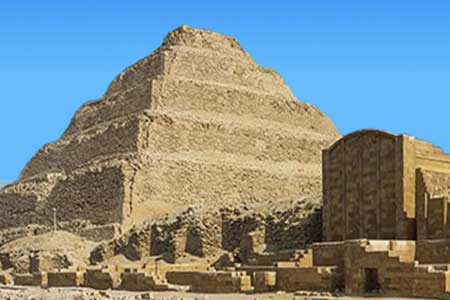
The Old Kingdom of Saqqara, lasting from 2700 to 2200 BCE and known as the "Age of the Pyramids," marks a period of innovation in Egyptian history. The Step Pyramid, constructed around 2670 BCE for King Djoser, is the earliest known Egyptian pyramid and was designed by Imhotep, who is recognized as the first architect. Ancient Egypt is famous for its architectural advancements, particularly the shift from mud-brick to cut stone construction.

This era also saw significant developments in sculpture, notably relief sculpture that projects from a flat background, as well as vibrant wall paintings and hieroglyphics used in funerary temples for the afterlife. Rising 205 feet (62.5 meters) with six tiers, the Step Pyramid is the oldest monument built with cut stone. Imhotep's architectural innovations included stone columns in the entrance corridor resembling bundled reeds and capitals designed to look like papyrus blossoms, along with relief sculptures and glazed wall panels in the underground complex that would influence structures for millennia.

1.) A frieze of cobras symbolizes protection for King Djoser in front of his Stepped Pyramid in Saqqara Egypt.
2.) The Step Pyramid of King Djoser is Egypt's first true pyramid built of cut stone at Saqqara around 2630 BC by the first known architect, Imhotep
3.) The Stepped Pyramid complex, Part of the Enclosure Wall at the South-side, 3rd Dynasty, 27th century BCE., Saqqara, Egypt.
1.) Entrance to the Stepped Pyramid Complex in Saqqara for the first time introducing columns made of cut stone..
2.) The entrance colonnade corridor leading into the funerary complex is a narrow 1.05 m (3.4 ft) wide by 6 m (20 ft) long corridor this is followed by a wider corridor flanked by..
3.) 40 limestone columns, each nearly 6 m (20 ft) tall and were fashioned for the first time to resemble bundled reeds that had between seventeen and nineteen ribs, 3rd Dynasty, 27th century BCE., Saqqara, Egypt
World's first stone columns at Saqqara Step Pyramid, the columns made of cut stone are 20 ft tall and were fashioned for the first time in history to resemble bundled reeds that had between seventeen to nineteen ribs, Saqqara, Egypt.
Memphis, Wall with Columns, Saqqara Necropolis, A view on Temple 'T' with the Step Pyramid in the background, Saqqara, Egypt.
The false columns in the open court of the House of the North have papyrus-shaped capitals, these columns were nothing more than a rendering in highly raised relief and did not have a supporting function, Saqqara, Egypt.

 Sub-Menu

THE SEATED SCRIBE

The seated scribe statues are painted carved limestone, considered one of the earliest forms of ancient Egyptian sculpture, dating to the period of the Old Kingdom, from the 4th Dynasty, 2620–2500 BCE. The statue of the seated scribe from Saqqara is one of the most important examples of ancient Egyptian art because it displays a rare example of Egyptian naturalism. Unlike most Egyptian art, which is highly idealized and rigid, this sculpture shows a more realistic and natural depiction of the human form. The scribe's eyes are inlaid, conveying a sense of wisdom and psychological depth. His gaze gives the impression of meditation as if contemplating what he will write, capturing the moment of inspiration.

The role of the scribe was one of the most important in ancient Egypt, representing culture, science, knowledge, and literature. Scribes had administrative responsibilities and were key in preserving Egyptian history and oral traditions. They were among the few individuals who knew how to read and write and were highly regarded and well-paid for their skills. Many pharaohs and high-ranking officials would accompany their scribes into the Afterlife, believing that their skills would be beneficial in their second lives. Smarthistory/The Seated Scribe

The Seated Scribe, from Saqqara, 2600–2350 BCE, Egyptian Museum, main floor, gallery 46, Cairo
The Seated Scribe, Painted Limestone Statue of a Scribe, 2600–2350 BCE, Museum of Egyptian Antiquities in Cairo, called the “Cairo Scribe”, unearthed in 1893, at the Saqqara necropolis, Egypt
The Seated Scribe, unearthed in 1850, painted limestone, eyes inlaid with rock crystal in copper, 2600–2350 BCE, Saqqara, Egypt, In the Collection of: The Louvre Museum, Paris, France

 Sub-Menu

THE FALSE DOOR

False Doors in Ancient Egyptian Tombs A false door, or recessed niche, is an artistic representation of a door that does not function as a physical entryway. These symbolic features were either carved into walls or painted onto them. In ancient Egypt, false doors held profound spiritual significance: they were believed to serve as portals through which the soul of the deceased could freely enter and exit the tomb. Typically characterized by a recessed surface and a stylized central opening, the false door became a focal point of tomb architecture.

By the early Middle Kingdom, false doors were often integrated into rectangular stelae, combining architectural and epigraphic elements. They were commonly placed on the west wall of the tomb’s offering chapel, aligning with the Egyptian association of the west with the realm of the dead. Family members would present offerings on a slab before the door, believing that the spirit of the deceased could receive them through this symbolic threshold.

First appearing during the Third Dynasty of the Old Kingdom (circa 27th century BCE), false doors became widespread in tombs from the Fourth to Sixth Dynasties. Typically carved from a single block of limestone or wood, they were designed to resemble real doors, often painted to mimic granite. These structures evolved artistically over time, featuring intricate carvings, depictions of daily life, and inscriptions detailing the deceased’s name, titles, and standardized offering formulas.

False doors functioned as symbolic gateways between the worlds of the living and the dead. They facilitated communication with the deceased and were considered sacred spaces where divine and ancestral presence could manifest. Though central to tomb architecture, it was rare to find false doors on the sides of coffins, as their ritual function was tied to the tomb’s spatial orientation and ceremonial use.

False Door & Mastaba of Ti, 6th dynasty 2345-2181 BCE, Saqqarawhere's gary
The false door in the Tomb of Mehu, "Possessed by the spirit of Mehu & caught on film" danderson4
The funerary statue and false door of Mereruka, "Possessed by spirits" 2345-2181 BCE, Saqqaranot so innocent
False door with statue from tomb of Iteti Ankhiris, Excavated by A. Mariette in 1861, 6th dynasty 2345-2181 BCE, Saqqara Necropolis, collection of: The Egyptian Museum, Cairo, Egypt
False Door on West Wall of Tomb Chapel of Raemkai: 5th dynasty 2400 BCE, collection of: The Met, New York City
False door of Nefer-Seshem-Ptah, Sakkara, 2300 BCE, Brooklyn Museum Archives (S10|08 Sakkara, image 9947)Wikimedia Commons
1.) The false door in the Tomb of Mehu, chief justice and vizier
2.) for King Teti, 6th dynasty 2345-2181 BCE, Saqqara
3.) danderson4 (Falsely recreated by Richard Brafford)
The false door in the Tomb of Mereruka: 6th dynasty 2345-2181 BCE, Saqqaranot so innocent
False door and architrave of Ptahspepses. From the Tomb of Ptahshepses at Saqqara, collection of The British Museum: Attribution-ShareAlike 4.0
False door in the area of the mastaba dedicated to Watetkhethor, wife of Mereruka and daughter of Pharaoh Teti, Sakkara, 2345 BCEAidan McRae Thomson
False Door of the Royal Sealer Neferiu, 6th dynasty 2345-2181 BCE, SaqqaraThe Met, New York City
Tomb of Inefrt V, False door, which was used by the ka, or spirit Duke & Wally
False door of Princess Sesheshet Idut, 2330 BCE, Saqqara Richard Mortel (Prof. Mortel) Attribution 2.0 Generic
 Sub-Menu TOMB EMBELLISHMENT
The ancient Egyptians utilized relief sculpture, a three-dimensional artwork that projects from a flat background, such as tomb walls adorned with paintings and hieroglyphics. These inscriptions often featured special prayers, assisting pharaohs and others on their journey to the afterlife. The term "hieroglyph" originates from the Greek words "hieros," meaning 'sacred,' and "gluptien," meaning 'carved in stone.' Hieroglyphs were commonly inscribed on tomb walls, particularly in texts like "The Book of the Dead," which contained spells and prayers designed to guide the deceased through the afterlife and protect them during their journey to the next world.

These hieroglyphs were believed to possess magical powers, helping the deceased overcome the challenges of the afterlife. The underworld, known as the Duat, had a single entrance. Upon entering this realm, a soul would encounter a corridor lined with captivating gods, including Thoth, Isis, and the hawk-headed Horus. After this, the deceased would be presented to Osiris, the ruler of the underworld and judge of the dead. Osiris would assess the virtue of the deceased's soul by the weight of a feather and grant a peaceful afterlife to those deemed worthy.

1.) Relief of Mastaba tomb of Mereruka seated before the offerings table,
2.) servers preparing and bringing funerary food,
3.) 2360 BCE, Saqqara Necropolis, Egypt, Photo:kairoinfo4u
1.) Relief of Mastaba tomb of Mereruka depicting priests and servants
2.) bringing food offerings for the Afterlife,
3.) 2330 BCE; Saqqara Necropolis, Egypt, Photo:kairoinfo4u
1.) Mastaba tomb of Kagemni guarding Hieroglyphic text and wall painted relief,
2.) depicting Vizier Kagemni, in the left column, with a list of sacrificial offerings,
3.) fat cattle, poultry from the three courts, desert game and fruits from vast waters, Saqqara Necropolis, Egypt, Photo:kairoinfo4u
1.) Mastaba tomb of Mereruka, wall sculpture relief of scribes rendering account of Mereruka's estate, of agriculture, tending cattle, papyrus harvest, continue next...
2.) fishing with dip nets, men in papyrus boats tricking cattle into crossing a stream, they take a calf away from its mother, sailing away slowly to force the mother to follow them. Continue next...
3.) Thus, the entire herd follows, and the job is done: 2360 BCE, Saqqara Necropolis, Egypt, Photo:kairoinfo4u
Alabaster Sphinx, early 18th Dynasty, attributed to either Amenhotep I or Thutmose I, Memphis Museum, Saqqara, Egypt.
I am at the Saqqara Necropolis, home of King Djoser's iconic Step Pyramid and the Old Kingdom Mastaba tomb of Mereruka, Saqqara, Egypt.
Rameses II: Colossal Statue Located in the remainings of ancient Memphis, a 10-meter length statue carved from limestone was discovered near the temple of god “Ptah” in 1820, Saqqara, Egypt.
Pharaoh Djoser, 2649-2611 BCE, of the 3rd Dynasty, Saqqara, Egypt, carved limestone, Egyptian Museum, is the oldest known life-sized Egyptian statue, 27th century, BCE,ShareAlike 2.5
Djoser's step pyramid is a structure that uses flat platforms that steps back receding from the ground up, architect: Imhoptep, dated: 27th century BCE., Saqqara,
Imhotep, architect of Pharaoh Djoser's step pyramid who reigned 2630-2611 BCE, The bronze figurine of Imhotep, dated: 332 BCE, from the Louvre Museum, Paris, France,ShareAlike 2.5

 Sub-Menu STEP PYRAMID HISTORIC PHOTOS Historical photography of the Step Pyramid complex and the necropolis at Saqqara in Memphis dates back almost two hundred years. Monuments of ancient Egypt gained significant popularity in the early years of photography. French academician François Arago (1786-1853) endorsed this new medium in 1839, claiming it would provide a labor-saving method to copy "the millions and millions of hieroglyphics that entirely cover the great monuments at Thebes, Memphis, Karnak, and so on." Immediately, artist-travelers began bringing cameras and photographic plates made of metal, and later glass, to the region to document the famous sights previously known to Westerners only through the artists' interpretations.
The Pyramids of Sakkarah from the North East, Date: 1857, Medium: Albumen silver print, Photo: William Henry Goodyear, 1846–1923, Source: Brooklyn Museum:ShareAlike 2.5
A statue of Ramses II lying down amid a stand of palm trees at Memphis, date: 1890, Photographer: H.W. Dunning: ShareAlike 2.5
History of Egypt, Chaldea, Syria, Babylonia and Assyria, Date: 1903, Photographer: Maspero, G. (Gaston), 1846-1916, Sayce, A. H. (Archibald Henry), 1845-1933, Publisher: London, Grolier Society Source:Public Domain
The Step Pyramid at Sakkara, TIMEA, Date: 1902, Photograph of the Step Pyramid at Sakkara, Source: E. A. Wallace Budge:ShareAlike 2.5
Excursion in the desert of Sakkara, Date: 1895, Author: Rijks Museum: ShareAlike 2.5
View of the Step-Pyramid of Sakkâra, TIMEA, Date: 1885, Description: Pyramid with stair-step sides, Line drawing, Publisher: Karl Baedeker, Source: Travelers in the Middle East Archive, TIMEA:ShareAlike 2.5
Berard-Pyramids, Date: 1881, Painting of the Step Pyramid at Sakkara, Author: Évremond de Bérard (1824-1881), Source: Kahn & Associates:ShareAlike 2.5
Hermitage hall 100, Egyptian hall 46, Date: 14th century BCE, king's fan-bearer Ipy with his depiction in front on god Anubis, Limestone, Author: Netelo, Saqqara licenses 4.0
Egipto, 1882 "Pirámide de Sakkara" (21409736136), Date: 1882, Description: Pyramid with stair-step sides, Line drawing, Ilustrador: Karl Werner, 1821-1888, Source: Pirámide de Sakkara ShareAlike 2.5
Lamenting Women, from the tomb (TT55) of Ramose, 1411–1375 BCE, Author: Unknown author, Source: Science & Avenir Hors Série n°157 - Janvier/Février 2009: Public Domain 1.0
Tomb of Ptahmose, Saqqara (Memphis) MET DP262086, Date: 1859, Medium: Albumen silver print from paper negative Author: Metropolitan Museum of Art, Public Domain 1.0
Lepsius-Projekt tw 1-1-38, Date: 1849, Description: Pyramid with stair-step sides, Line drawing, Author: Karl Richard Lepsius (1810–1884) Source: Lepsius-Projekt Sachsen-Anhalt:ShareAlike 2.5

Sub-Menu THE PYRAMIDS of SNEFRU
Pyramid building reached its maturity in the reign of Pharaoh Snefru of the 4th Dynasty (2543–2436 BCE); he constructed three pyramids; the first was known as the Bent Pyramid due to its double slope collapsed, the second was known as the Meidum Pyramid that collapsed too, the third was successfully known as the first true pyramid—called the Red Pyramid at Dahshur; it is about 220 meters (722 feet) wide at the base and 104 meters (341 feet) high, it is Egypt's first successful construction of a "true" smooth-sided pyramid.

Archaeologists speculate the Red Pyramid design built at a slope of 43° was an outcome of engineering crises experienced during the construction of Sneferu's two earlier pyramids. The first of these, the Pyramid at Meidum, collapsed in antiquity. In contrast, the second, the Bent Pyramid, had the angle of its inclination dramatically altered from 54 to 43 degrees part-way through construction, and it collapsed. The Red Pyramid was built at a slope of 43°, 105 meters (344 ft) high, and 220 meters (720 ft) wide; it is believed that Pharaoh Sneferu was buried in the Red Pyramid in 2589 BCE. Considering that the remains of King Sneferu have not yet been found or positively identified, it may still be possible that his sarcophagus and mummy lie hidden in his Red Pyramid in a hidden chamber.
The Meidum Pyramid, built by King Snefru, was known as the "collapsed pyramid" because of its ruined state; it was built around 2600-2575 BCE.
Sneferu's Bent Pyramid at Dahshur was modified during construction; the inclination angle changed from 55° to about 43° due to instability. Soon, it began to collapse around 2600 BCE, and the work was abandoned.Attribution 3.0
The Red Pyramid of Dahshur, named for the rusty, reddish hue of its red limestone, is the first true pyramid; it was built around 2575–2563 BCE; it is the third largest Egyptian pyramid after Khufu and Khafre at Giza.
Statue of Egyptian Pharaoh Sneferu, Egyptian Museum, Cairo, carved limestone, 2600 BCE.Attribution-Share Alike 3.0
Prince Rahotep (son of Sneferu) and his wife Nofret, tomb statues from Meidum Pyramid, 2600 BCE.Share Alike 4.0 International
Statuette of the sitting King Khufu, builder of the Great Pyramid, 2600 BCE, found in 1903 in Abydos, Egyptian Museum in Cairo:GNU Free Documentation License

 Sub-Menu THE GREAT PYRAMIDS
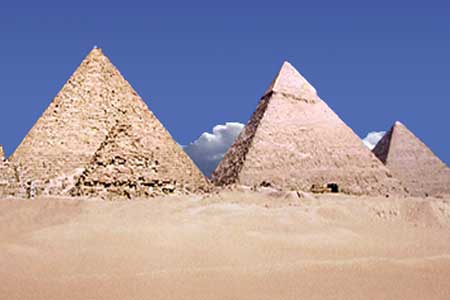
The Great Pyramids of Giza were the burial places for Egyptian royalty during the Old Kingdom. The three large pyramids at Giza were built for three generations of Egyptian kings: Sneferu's son Khufu, his son Khafre, and his grandson Menkaure. Several smaller pyramids at Giza are also constructed for these kings' wives and mothers. Approximately 80 pyramids were built from the Kingdom of Kush, now in modern-day Sudan, to the pyramids at the Giza plateau.

Pharaoh Khufu built the Great Pyramid for his tomb around 2600 BC. It took about 26 years, and it's the highest at 481 feet (147 meters) tall, almost as high as a 50 story skyscraper and has a base of 756 feet (230.33 meters). The Great Pyramid is built at an angle of approximately 51°50 degrees on each side and aligned with the constellation Orion. The Great Pyramid is the oldest of the Seven Wonders of the Ancient World and the only 7th wonder that has remained largely intact. To ensure that the king would join the circumpolar stars (situated around the earth's north pole), the Great Pyramid was laid out facing north toward the "indestructible" stars.

1.) Take a camel ride into the Giza Desert to get this perfect picture view vantage point, the first Great Pyramid you see is Menkaure, the smallest of the three main pyramids, built in 2510 BCE, 213 feet high, Slop: 51°20, continue next;
2.) In the middle is Khafre, the second largest and the second tallest built in 2570 BCE, 448 feet high, Slop: 53°10' it is the only pyramid that still has cladding at the top, continue next;
3.) In the far back is Khufu the Great Pyramid, built in 2600 BCE, 481 feet high, Slop: 51°50
The Great Kufu Pyramid with the Khufu ship museum at its side, and the Great Sphinx, 4th Dynasty, 2613–2494 BC. The Giza Plateau, Cairo
Close-up of the Great Pyramid of Khufu, 481 feet high,also known by its Greek name Cheops, built on the Giza Plateau, 4th Dynasty, 2600 BCE.
The Great Pyramids of Giza with moi and my itchy finger (how lovely!) on camel back; this view vantage point is a half-hour camel ride into the desert, The Giza Plateau, Cairo
I, with resting camels and The Great Pyramid of Khufu, The Giza Plateau, Cairo
I and other fellow tourist sitting on the base of The Great Pyramid of Khufu, Cairo
I inside the burial chamber of the Great Pyramid of Khufu, The Giza Plateau, Cairo
View of King Khafre's pyramid from the outskirts of Cairo city limits, on the Giza Plateau, Cairo
King Khafre's pyramid is surpassed only by the Great Pyramid, built by his father Khufu, the 4th Dynasty, 2613–2494 BC. The Giza Plateau
View of Khafre's Pyramid from the open desert of the Giza Plateau, the 4th Dynasty, 2613–2494 BC. Cairo
I and other tourist on camelback with The Great Pyramids of Khafre, Khufu, and the Great Sphnix on the Giza Plateau
The Great Pyramid of Khufu, of the Giza Plateau, 4th Dynasty, 2613–2494 BC. The Giza Plateau, Cairo
I in front of a Avenue Sphnix in its third shape, a body of a lion and head of a pharaoh, the statues extend over a mile to Luxor Temple, Cairo

 Sub-Menu HISTORIC PHOTOS OF THE PYRAMIDS
Historical documentation of 19th-century photography, etchings, and oil paintings on canvas of the pyramids. Photographers and artists have flocked to the Egyptian desert to see the colossal sculptures, monuments, and especially the Giza Plateau to capture the massive size of the pyramids specifically the Great Pyramid at 481 feet high, known as one of the Seven Wonders of the Ancient World.
The Great Pyramid and The Sphinx, Date: 1858, Photograher: Francis Frith, 1822-1898, Collection of: The Met, New York City,Public Domain
Pyramids of Giza, Date: 1860, Process: albumen print, Photographer: W. Hammerschmidt, Source: Getty Museum:Public Domain
Pyramide de Chéops (Grande Pyramide), Medium: Salted paper print from paper negative, Date: 1852, Photograher: Félix Teynard, French, 1817–1892, Collection of: The Met, New York CityPublic Domain
The Great Pyramid from the plain, Abstract/medium: 1 photographic print, Date: 1862, Photo by Francis Frith, 1822-1898, Source: Library of Congress:Public Domain
Five on top of the Great Pyramid LCCN2004707589, 1 slide : lantern, hand colored, date: 1894, Photographer: William Henry Jackson, 1843–1942, Collection: Library of Congress:Wikimedia Commons
Great Pyramid (5147211672).jpg, Date: 1890, Description: Coloured photo of the pyramid of Khufu showing the north and west faces of the pyramid, ca. 1890. Photographer: Vincent Brown:Attribution 2.0
The Great Sphinx of Giza partly under sand, Date: 1839, Object type: 19th century oil painting, Artist: David Roberts, 1796–1864, Source: Berger Collection:Wikimedia Commons
Giza pyramids seen through the installation Together by Lorenzo Quinn during "Forever is Now" exhibition, date: 2021, Photographer: Mona Hassan Abo-Abda:ShareAlike 4.0
View of the Great Pyramid of Giza, Watercolor, Date: 1760, Artist: Luigi Mayer, 1755–1803,Wikimedia Commons
Man riding a camel in front of the Great Pyramid, Date: 1900, Source: Travelers in the Middle East, TIMEA:Share Alike 2.5 Generic
A man, a camel, an oasis ?, and the pyramids of Giza, date: 1917, Photo: Brown & Dawson, The NY Times archive:Wikimedia Commons
The Great Pyramids during the Inundation - TIMEA, Date: 1878, Author: Georg Ebers, 1837-1898, Fondren Library:Share Alike 2.5 Generic
The pyramids, Photo: Henri Béchard, Date: 1890Wikimedia Commons
Pyramids, Digital ID: 88405, date: 1924, Inscribed on negative, George D'Andria/ Pyramids/ 2-29-24Wikimedia Commons
Egypt: the pyramids at Giza and the Sphinx, Colour lithograph by G.W. Seitz, 1878, after Carl Werner, 1870Attribution 4.0

 Sub-Menu
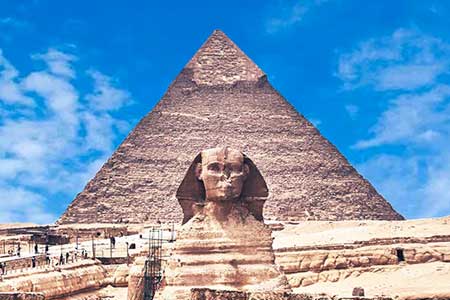
THE GREAT SPHINX The Pyramid of Khafre and the Great Sphinx: The colossal Great Sphinx of Giza was built during the reign of King Khafre, the builder of the second pyramid at Giza. In ancient Egypt, a sphinx was a mythical creature with the body of a lion, symbolizing the strength and power of the kingship and a human head, usually that of the ruling Pharaoh wearing the royal headdress. The Great Sphinx is one of the earliest and largest monolithic statues in the world, 241 feet (73.5 m) long, 63 feet (19 m) wide, and 66 feet (20 m) high.

I with The Great Sphinx of Giza, 2575 BCE, a reclining mythical creature with the head of a human and the body of a lion, The Giza Plateau, Cairo
A close view of King Khafre's enormous pyramid with the Great Sphnix directly in front, 4th Dynasty, 2575 BCE, The Giza Plateau, Cairo
I with other tourist listening to tour guide about The Great Sphinx of Giza, 2575 BCE, The Giza Plateau, Cairo
I next to the Great Sphnix of Giza, 2575 BCE, a reclining mythical creature with the head of a human and the body of a lion, The Giza Plateau, The Giza Plateau, Cairo
The Great Sphinx of Giza, the colossal limestone statue directly in front of King Khafre's pyramid, 2575 BCE, The Giza Plateau, Cairo
The Great Sphinx of Giza, a colossal limestone statue that likely dates to the reign of King Khafre 2575 BCE, The Giza Plateau, Cairo
I next to the Great Sphnix of Giza, 2575 BCE, a reclining mythical creature with the head of a pharaoh and the body of a lion, The Giza Plateau, Cairo
The Great Sphinx of Giza, the colossal limestone statue directly in front of King Khafre's pyramid, 2575 BCE, The Giza Plateau, Cairo
Side view with a afternoon shadow of the Great Sphinx of Giza, 2575 BCE, The Giza Plateau, Cairo

 Sub-Menu THE SPHINX HISTORIC PHOTOS Historical documentation with 19th-century photography and oil paintings of the Great Sphinx. While photography has only been around for about 200 years, photographers have flocked to the Giza Plateau in the Egyptian desert to capture images of the enigmatic creature with the head of a pharaoh and the body of a lion.

Zangaki. 0365. Le Sphynx et les Pyramides, Images by Zangaki Brothers, Date: 1870s-1890s, Source: Scan of the original photograph digitized by: Elekes AndorAttribution 3.0
Brooklyn Museum, Egypt, Medium: Albumen silver print from glass negative, Lantern Slide Collection:The Brooklyn Museum
Sphinx an the Pyramids of Ghiza, Date: 1880, Photo: Beniamino Facchinelli, 1839-1895, Source:Bibliothèque nationale de France
The Sphinx and pyramid of Cheops, Egypt, Albumen prints: 1890-1900, publisher: Strohmeyer & Wyman, NYC, 1896, Repository: Library of CongressPublic Domain
1.) Bonaparte Before the Sphinx, (French: Bonaparte devant le Sphinx) Medium: Oil on canvas, Date: 1886, Artist: Jean-Léon Gérôme, 1824-1904
2.) Napoleon Bonaparte during his Egyptian campaign of 1798, positioned on horseback in front of the Great Sphinx of Giza, with his army in the backgroundPublic Domain

 Sub-Menu THE KARNAK TEMPLE
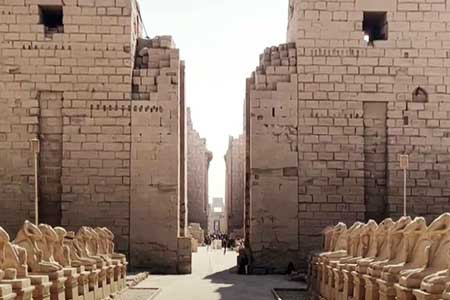
The Karnak Temple Complex is an impressive assembly of temples, pylons, chapels, and various structures located near Luxor, Egypt. Construction began during the reign of Senusret I (1971–1926 BC) in the Middle Kingdom (circa 2000–1700 BC) and continued into the Ptolemaic Kingdom (305–30 BC). The Karnak and Luxor Temples are strategically positioned approximately a mile and a half apart within this monumental temple complex, which stands on the historic site of ancient Thebes, situated on the east bank of the Nile River. These magnificent temples are linked by the Avenue of Sphinxes, a crucial pathway that lay buried under layers of sand for millennia. Archaeologists uncovered some of the Sphinx statues in 1949, and extensive excavations between 1984 and 2000 effectively restored the connection between the Karnak and Luxor temples.

In ancient Egypt, the Ram-headed sphinxes undoubtedly represented Amun, the chief deity worshipped at the Great Temple of Karnak. Amun, as a powerful and primordial god, is typically depicted with the head of a curved-horned ram, which is his sacred animal. The lion bodies and ram heads of the sphinxes symbolize Amun's strength, serving the vital role of warding off evil forces. Each sphinx protects, between its forelegs, a standing statue of Ramesses II (The Great), who reigned from 1279 to 1213 BCE, firmly reinforcing the grandeur of this ancient civilization.

Ram-headed sphinxes, are believed to represent the god Amun, the chief deity worshipped at the Temple of Karnak
The Avenue of Sphinxes was buried under layers of sand over the centuries, the first trace of the avenue was found by Archaeologists in 1949
Since then hundreds of Spinxes have been found under 30 feet or more of sand, Temple of Karnak
1.) The Avenue of Sphinxes in front of the first pylon entrance of Karnak Temple, also known as Rams Road, it connects Karnak Temple with Luxor Temple to the south about a mile away, Luxor Temple
2.) Construction of the Avenue of Sphinxes began during the New Kingdom and completed during the reign of 30th Dynasty ruler Nectanebo I 380–362 BC, Karnak Temple, Luxor
3.) The Avenue of Sphinxes was buried under layers of sand, the first trace of the avenue was found in 1949 when Egyptian archaeologists discovered eight statues near Karnak Temple, Luxor
4.) The Avenue of Sphinxes in front of the first pylon entrance of Karnak Temple
5.) 
6.) 
7.) The Avenue of Sphinxes looking away from Karnak Temple
8.) 
9.) 

Back to Top THE GREAT HYPOSTYLE HALL
One of the most remarkable achievements in Egyptian architecture is the Great Hypostyle Hall of Karnak. Construction of this impressive structure began during the 19th Dynasty in the 13th Century BCE, particularly during the Ramesside period, when Egypt was governed by a succession of eleven pharaohs named Ramesses. Situated within the Karnak Temple's Precinct of Amon-Re, the Great Hypostyle Hall ranks among the most visited monuments of Ancient Egypt, second only to the Great Pyramids of Giza. Covering an area of 5,000 square meters (approximately 54,000 square feet), the hall was originally supported by 134 columns arranged in 16 rows, although the roof has since collapsed.

The two central rows of columns are particularly striking, measuring 10 meters (33 feet) in circumference and reaching an impressive height of 24 meters (70 feet). The design of the hall features a central space that is higher than its adjoining areas, allowing for clerestory lighting. This innovative architectural element includes windows positioned above eye level in a raised section of the walls, permitting both light and fresh air to fill the hall. The earliest evidence of this clerestory lighting can be found within the Hypostyle Hall itself.

1.) This is the first architectural rendering of the Hypostyle Hall
2.) compiled by scholars of Napoleon's expedition to Egypt, 1798-1801
3.)
1.) Entrance to A panorama of the great hypostyle hall at Karnak, the hall has 134 sandstone columns with the center twelve columns standing at 69 feet, 1250 B.C.E., 18th and 19th Dynasties, Temple of Karnak
2.) View of the main axis of the Hypostyle Hall with its twelve large columns, the hall has 134 sandstone columns with the center twelve columns standing at 70 feet, 1250 B.C.E., 18th and 19th Dynasties, Temple of Karnak
3.) Hypostyle hall architecture: is an interior space whose roof rests on pillars or columns, the word hypostyle means literally “under pillars,” 19th Dynasty 1290–1224 BC, instituted by Hatshepsut, Temple of Karnak
Entrance to Karnak Temple, the Hypostyle hall has 134 sandstone columns with the center twelve columns standing at 69 feet, 1250 B.C.E., 18th and 19th Dynasties, Temple of Karnak, Luxor
The earliest evidence for clerestory lighting comes from Karnak, 19th Dynasty 1290–1224 BC, Luxor, Egypt
The center of the Hypostyle hall is taller than the spaces on either side, which allows for clerestory stone window grilles to let in light and air into the dark space below, Temple of Karnak, Luxor
The earliest evidence for clerestory lighting comes from Karnak, 19th Dynasty 1290–1224 BC, Luxor, Egypt
The center of the Hypostyle hall is taller than the spaces on either side, which allows for clerestory stone window grilles to let in light and air into the dark space below, Temple of Karnak, Luxor
The earliest evidence for clerestory lighting comes from Karnak, 19th Dynasty 1290–1224 BC, Luxor, Egypt
Karnak Tempel Hypostyle columns

 Sub-Menu
The Egyptian Obelisk
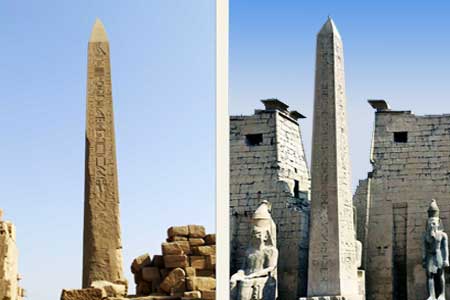
Hatshepsut's Obelisk at Karnak Temple, originally erected in the year 1457 BC, remains standing in its original location, making it the tallest surviving obelisk in Egypt. The obelisk is a symbol of Hatshepsut's power and her devotion to the god Amun. Inscriptions on the obelisk celebrate her reign and dedication to the temple. It is one of two obelisks she had commissioned for the temple, and although its twin fell and broke, this obelisk remains standing. The obelisk is made of red granite and is 29.5 meters (97 feet) high with a base measuring 9.7 sq. feet that tapers to a top of 4.85 sq. feet, crowned with a pyramidion or pointed tip of the obelisk, symbolizing the rays of the sun falling on earth. Its flawless geometry and balance allow it to stand solely by its weight, making it an enduring engineering marvel for 3,482 years.

Quarrying such a monument required remarkable skill. Ancient Egyptians used dolerite, a stone harder than Aswan granite, to pound the obelisk free from bedrock without chisels. These monolithic structures were shaped with precision, then transported using wooden rollers, floated down the Nile, and hauled to their final destinations. Erecting the obelisk was the most difficult part of the process, and since no architectural papyri survive detailing how Egyptians built pyramids or temples, the exact method remains unknown.

Obelisks are tall, four-sided, tapering monuments made from a single piece of stone, typically red granite, and topped with a pyramid-like shape. They were deeply symbolic in ancient Egyptian culture, closely associated with the sun god Ra and placed at temple entrances to represent the sun’s rays. During Akhenaten’s religious reforms, obelisks were seen as petrified rays of Aten, the sun disk. They were also believed to guide souls to the afterlife, reinforcing their spiritual significance. Obelisks first appeared during the Old Kingdom around 2300 BCE and became especially prominent in the New Kingdom. Their stability depended entirely on their weight and geometric balance, with the base carefully freed by digging caverns and shoring up the stone before transport.

Today, only 29 Egyptian obelisks survive worldwide, with more located in Italy than in Egypt. Of these, 22 date to the New Kingdom, four to the Late Period beginning in 525 BCE, and one to the Ptolemaic Period starting in 305 BCE. Many were relocated during the Roman conquest of Egypt and later gifted to major cities in modern times. Notable examples include the Luxor Obelisk in Paris and Cleopatra’s Needles in London and New York City. Only five still stand at their original temple sites. The largest known obelisk, the Unfinished Obelisk, remains in its quarry and was never erected. Had it been completed, it would have stood 137 feet tall and weighed approximately 1,090 tons. Unlike ancient obelisks, which were monolithic and carved from a single stone, most modern obelisks are constructed from multiple rocks.

Hatshepsut's (reign 1479–1458 BCE) Obelisk, the tallest in Egypt at height 29 meters (97 feet), is still standing today on its original site in the Temple of Amun at the Great Temple complex at Karnak
The Obelisk of Tuthmosis I (reign 1526–1513 BCE) at the gateway of the Fourth Pylon at Karnak Temple, height 21.7 meters (71 feet), Temple complex at Karnak
Entrance to Luxor Tempel, the Obelisk of Ramesses II, (reign 1279–1213 BCE), Egypt, height 25 meters (82 feet), it's other pair was moved in 1833 to the Place de la Concorde, Paris
The unfinished obelisk is the largest known ancient obelisk located in the northern region of the stone quarries of ancient Egypt in Aswan, If finished it would have measured around 41.75 metres (137.0 ft)
The obelisk and wider quarry were inscribed on the UNESCO World Heritage List in 1979 along with other examples of Upper Egyptian architecture
The obelisk was ordered by Hatshepsut in 1458 BCE, the creators began to carve it directly out of bedrock, but cracks appeared in the granite and the project was abandoned.


NOVA: "Secrets of Lost Empires: Pharaoh's Obelisk"
NOVA: "Secrets of Lost Empires: Pharaoh's Obelisk", Asset Copyright:2010 WGBH Educational Foundation. All rights reserved.  Rights do not expire.Public Domain

Karnak Statuary
Osiris sculpture holding two anks the symbol of immortality, Wadjet Hall, carved sand stone, 1230 BCE. Karnak Temple
Sign-bearer statue of Seti II, 1292 BC, Karnak, Temple
Headless granite statue of god Ptah at Ptah Temple, Karnak Temple
Ruins of a colossal statue, carved granite, 1230 BCE, Karnak Temple
Ruins of a colaspped colossal statue, carved granite, 1230 BCE, Karnak Temple
Gate of Ramses IX with obelisk by Thutmosis I and Ruins of a Colossal Statue, carved granite, 13th century BC. Karnak Temple
Statue of Amun Ra, carved sand stone, 1230 BCE, Karnak Temple
Pharaoh Thutmose III, holding two anks the symbol of immortality, carved sand stone, 1230 BCE, Karnak Temple
Statue headdress & face of Tutankhamun, 1230 BCE, Karnak Temple
1.) Relief from the sanctuary of the Temple of Khonsu at Karnak,
2.) Relief from the sanctuary depicting Ramesses III Representation of the Temple of Khonsou at Karnak
3.) Relief from the sanctuary depicting Ramesses III with the characteristics of Menthu the sun disk and the two plumes, Karnak TemplePhoto Kairoinfo4u
1.) Sekhmet, The Lioness Goddess of Ancient Egypt
2.) her shrine is The Temple of Ptah in the immense Karnak Temple
3.) she is the companion of Ptah, the god of healing, 18th Dynasty, 1550/1549 BC. Karnak Temple
1.) Outside North Wall of the Great Hypostyle Hall, The Sacred Mushroom Rites, and the Hidden Meaning of the Egyptian Ankh,
2.) while Seti I makes offers to Clepsydra in the Ished Tree, Thoth inscribes the Kings Name on a leaf
3.) 13th century BCE, Karnak Temple Complex, Luxor

 Sub-Menu BARQUE CHAPLE OF RAMSES III
First Barque Chapel of Ramses III (1184–1153 BC), Osiride statues depict the king wrapped in mummy-like cloth, emphasizing their connection to the afterlife. The first court is lined with eight Osiride statues of the king, with those to the west wearing the crown of the red crown of the south, while those on the east, wear the crown of the north. Beyond the court is a vestibule also fronted by Osiride pillars leading into a small hypostyle hall, which in turn leads into three chapels for the barques of Karnak.

1.) Pylon, entrance to the Barque Temple of Ramesses III, this area was enclosed by the court yard constructed by Shoshenq I (943-922 BCE), the Barque Temple of Ramesses III, Karnak Temple
2.) The shrine’s entrance is fronted by a small pylon adorned with scenes of the king smiting his enemies and flanked by two 20 foot (6 meter) statues carved from red sandstone of Ramses III, the Barque Temple of Ramesses III, Karnak Temple
3.) This 200-foot-long temple features three bark chapels, a hypostyle hall of eight columns, a vestibule with four columns, and an open court, the Barque Temple of Ramesses III, Karnak Temple
4.) Temple of Ramses III, The first court is lined with eight Osride statues of the king; the west side wear the red crown of the south, Karnak Temple
5.) while those on the east side wear the white crown of the north. Karnak Temple
6.) The Osiride statues on the west hold the hek scepter in the left and and the nekhakha scepter in their right, Karnak Temple
7.) Temple of Ramses III, Inside the one of three Barque Chapels, looking into the court-yard, Karnak Temple
8.) Inside the Barque Chapel looking out past the small courtyard of the Temple of Ramesses III towards the far gate to the Forecourt with the colossal column of the Kiosk of Taharqa, Karnak Temple
9.) Temple of Ramses III, Inside the one of three Barque Chapels, looking into the court-yard, Karnak Temple
10.) Temple of Ramses III, The Osiride statues inside the Barque Chapel courtyard, Karnak Temple
11.) Inside the Barque Chapel small courtyard of the Temple of Ramesses III looking out to the Forecourt of Karnak Temple
12.) Temple of Ramses III, The Osiride statues inside the Barque Chapel courtyard, Karnak Temple
13.) Great Temple of Karnak forecourt the main entrance into the temple but it was never completed
14.) The remaining colossal column of the Kiosk of Taharqa, built by the 25th Dynasty pharaoh Taharqa (690-664 B.C.) at the Karnak Temple Complex
15.) Colossal statue of Ramses II with his daughter, Princess Bintanath, Red Granite, Karnak Temple Complex

 Sub-Menu KARNAK HISTORIC PHOTOS
Historical documentation with 19th century photography of ancient Egyptian sites, especially from early archaeological excavations, act as a vital historical record, capturing the state of monuments before significant changes or restoration. Collectively, the earliest photographs of Egypt, whether daguerreotypes or prints made from paper and glass negatives are the accomplished expressions of a young medium flexing its muscles. They define a moment when ancient Egypt, still buried under 20 feet of sand like the Sphinx, would come to life after 3 thousand years and inspire a new generation of photographers in the 19th century, such as Félix Teynard, John Beasly Greene, Théodule Devéria, Felice Beato, Félix Bonfils, Lichtenstern and Harari, Francis Frith, etc.
Karnak Thèbes, Cour du Palais, Vue Prise de Point I, Imprimerie photographique H. de Fonteny et Cie, Photograph Salted paper print from paper negative, 1851, Photographer: Félix Teynard 1817-1892, Source: The Met, New YorkPublic Domain
Luxor Temple, carved sandstone statue of Ramesses the Great, 1303-1213 BCE., Photographer: Antonio Beato, Date: 1862, Technique: albumen print, Source: Rijks MuseumPublic Domain
Hector Horeau: Theben Zeno Fotografie, Daguerreotypie, Wasserfarben, 1841, Photographer: Hector Horeau, 1839-1928, Collection: 5,000 Masterpieces of Photography: Zeno.orgPublic Domain
Temple van Karnak, Ptolemey gateway & Temple of Konshu, Date: 1895, Photographer: Antonio Beato:CC0 1.0 Universal
Karnak, Great Hypostyle Hall, Watercolour, 1866, Artist: Richard Phene Spiers, 1838–1916, Victoria and Albert Museum:Public Domain
Decorated pillars of the temple at Karnac, Thebes, Egypt. Coloured lithograph by Louis Haghe after David Roberts, 1846, Wellcome Collection Gallery:Public Domain
Great Hall at Karnac, Thebes, Date: 1838 by: David Roberts (1796-1864), Tinted lithograph, from the book: Egypt & Nubia From Drawings Made On The SpotPublic Domain
Karnak, Gate of Ptolemy III, Mougins, Musée d'art classique de Mougins,CC0 1.0 Universal 
Temple de Louqsor, 88432 Zangaki, Photographer, 1860s-1920s, Repository: The New York Public Library. Photography Collection, Miriam and Ira D. Wallach Division of Art, NYPL Digital Gallery:Public Domain
Karnak, colonnade du Grand Temple, Photoglob Co., 1890-1910, 1 print: color photochrom ; sheet 21 x 27 cm, Library of Congress:Public Domain
Temple Of Khonsu, Flickr - Gaspa - Tempio di Karnak: ingresso, Photographer, Francesco Gasparetti:Public Domain
Karnak Temple of Amon, Hypostyle Hall, albumen print, date: 1865, Collection: A. D. White Architectural Photographs, Cornell University Library:Public Domain
Karnak Temple, Hypostyle Hall, date: 1906, Photographer, H.W. Dunning, Fondren Library:Public Domain
Pylon Gateway Arch, Abstract/medium: 1 photographic print : albumen, 1850, Library of Congress:Public Domain
Karnak, Abstract/medium: 1 photographic print: albumen, 1856, Photographer: Frank Mason Good, 1839-1928, Library of Congress:Public Domain
Karnak Temple colossi, 13th century BCE, Luxor,Photograph, Lantern Slide Collection, Date: 1870, Author: Brooklyn Museum:Public Domain
Karnak Temple colossi, 13th century BCE, Luxor, Photo: A Pylon with Colossi, Date: 1874, Author: William de Wiveleslie Abney, 1843–1920:Public Domain
Karnak Temple colossi, 13th century BCE, Luxor, Abstract/medium: 1 negative photograph, Statues of kings behind the 8th pylon, Date: 1900, Source: G. Eric and Edith Matson Photograph Collection:Public Domain
The same seated colossus as seen in the old photos above buried in sand and rubble, on the south side of the seventh pylon of the temple of Karnak, 13th century BCE, Luxor
A seated colossus on the south side of the seventh pylon of the temple of Karnak, 13th century BCE, Luxor
Tourist and guide standing next to the colossi of the seventh pylon of the temple of Karnak, 13th century BCE, Luxor

 Sub-Menu Luxor Temple
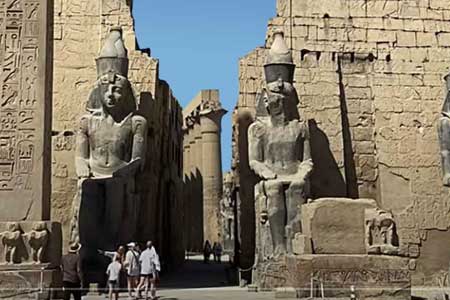
Luxor Temple: Monument to the Revival of Divine Sanctity serving as a primary spiritual center for the Theban Triad and the gods Amun, located a mile and a half south of Karnak Temple, Luxor Temple rises on the east bank of the Nile in the city of Luxor—the site of ancient Thebes. Constructed over centuries by pharaohs including Amenhotep III, Ramses II, and Tutankhamun, the temple embodies the grandeur of Egypt’s New Kingdom. For more than two thousand years, its entrance lay buried beneath 30 feet (9 meters) of sand, until excavations in the 1880s revealed its towering pylons. These monumental gateways stand 78 feet (24 meters) high and span 214 feet (65 meters) wide, adorned with sunken reliefs depicting Ramses II in the Battle of Kadesh—a vivid display of royal power and military triumph. Guarding the entrance are two colossal seated granite statues of Ramses II, flanked by four standing figures of the same pharaoh. Originally, a pair of 80-foot (25-meter) obelisks framed the gateway; today, only one remains in Luxor, while its twin stands in the Place de la Concorde in Paris.

The Avenue of Sphinxes and the Great Colonnade Hall, Stretching 1.86 miles (3 kilometers), the Avenue of Sphinxes forms a majestic processional route lined with over 1,000 statues—some ram-headed, others human-headed. These sphinxes were first uncovered by archaeologists in 1949, and extensive excavations between 1984 and 2000 reconnected the temples of Karnak and Luxor, restoring the ancient ceremonial pathway. Among the architectural marvels of this complex is the Great Colonnade Hall, an imposing structure nearly 61 meters in length. It features 28 towering columns, each rising 21 feet high, their surfaces adorned with intricate reliefs. The hall’s decorative program was completed during the reign of Tutankhamun, around 1330 B.C., adding a layer of regal symbolism to this monumental space.

1.) Two seated granite colossi of Ramesses II flank the entrance pylon of Luxor Temple, both colossus is 45 feet (14 meters) in height, and topped with the Double Crown of Upper and Lower Egypt, Luxor Temple
2.) Ramesses II still standing 13th century BCE, 82 foot, (25 meter) high pink granite obelisk, it is one of a pair, the other now stands in the Place de la Concorde in Paris, Luxor Temple
3.) Luxor Temple was the largest religious center in ancient Egypt, built by eleven pharaohs named Ramesses, starting in the 13th Century BCE, Luxor Temple
4.) After you enter through the pylon gateway you enter Ramesses II’s Peristyle Courtyard of papyrus bud columns and colossal statuary, Luxor Temple
5.) The great Court of Rameses II is 188 feet (57 m) long and 168 feet (51 m) wide. Seventy four papyrus columns, with bud capitals surrounding it, Luxor Temple
6.) In the Northwest corner of the court there is a shrine to Thutmose III, while in the southern part of the court you are surrounded by standing granite colossal statuary of Ramses II, Luxor Temple
7.) The Court of Amonhotep III measures 148 feet long (45 meters) by 184 feet wide (56 meters), with double rows of papyrus columns on three sides, Luxor Temple
8.) The Court of Amonhotep III leads into the Hypostyle Hall, which has 32 papyrus columns, arranged in four rows of eight columns, Luxor Temple
9.) At the rear of the Hypostyle Hall are four small rooms and an antechamber leading to the birth room, the chapel of Alexander the Great and the sanctuary, Luxor Temple
Colossal Head of Ramesses II in front of Luxor Temple's entrance pylon, 45 feet (14 meters) in height, and topped with the Double Crown of Upper and Lower Egypt, 12th century BCE, Luxor Temple
Statue of Isis, Nineteenth Dynasty, (1292 BC–1189 BC), Luxor Temple
Colossal Head of Ramesses II in front of Luxor Temple's 2nd entrance pylon, 45 feet (14 meters) in height, and topped with the Double Crown of Upper and Lower Egypt, 12th century BCE, Luxor Temple
Headless Ramesses II, 1230 BCE. Luxor Temple
Headless Statue of Isis in the shrine to Serapis, created by Emperor Hadrian (76-138 AD), Luxor Temple
HeadlessStatue of Pharaoh Merenptah, (1213-1204 BCE) son of Ramses II, Temple of Luxor, East Bank (Thebes)
A broken statue of a young King Tutankhamun and his consort Ankesenamun, carved sand stone, 1230 BCE. Luxor Temple
Tuthmosis III at Precinct of Amun-Re, Temple of Amun, Luxor Temple
A double statue of Amun and Mut with the facial features of Tutankhamun and Ankhesenamun, Luxor Temple, 13th century BCE,
The Great Colonnade of Amenhotep III measures 148 feet long, has seven pairs of 52 foot (16m) high open-flower papyrus columns, which still support their huge architrave blocks, Luxor Temple
I next to the Sitting Ramesses II Colossus inside Luxor Temple, sits at 45 feet (14 meters) high, carved granite
Two seated granite colossi of Ramesses II flank The Great Colonnade of Amenhotep III both colossus is 45 feet (14 meters) in height, and topped with the Double Crown of Upper and Lower Egypt,

 Sub-Menu Philae Temple
Philae: The Rescued Sanctuary of Isis located on Agilkia Island just South of Aswan, Egypt, is a stunning temple complex nestled within the reservoir of the Aswan Low Dam, downstream from the Aswan High Dam and Lake Nasser. When the dam was constructed in the 1960s, the Temple of Isis—dating back to the 7th century BCE—faced submersion. In a remarkable act of preservation, UNESCO and the Egyptian government intervened, carefully dismantling the temple and reconstructing it at a higher elevation on Agilkia Island. Despite centuries of flooding and damage from early Christian iconoclasm, the Temple of Isis remains one of Egypt’s most extraordinary sanctuaries. Its well-preserved columns and exquisite reliefs—especially the musical scenes in the Temple of Hathor—attest to the site’s artistic brilliance and spiritual significance. Philae is a must-visit for anyone drawn to Egypt’s rich cultural heritage. It stands not only as a monument to ancient devotion but also as a symbol of modern conservation.
1.) Vue de L'Ile de Philae Nubie
2.) View Of Philae Island, Nubia, painted oil on canvas, 1853
3.) Charles Théodore Frère, French painter, 1814–1888:Public Domain
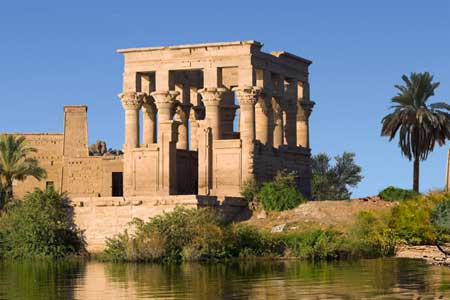
Trajan's Kiosk, is a hypaethral temple, in classical architecture, hypaethral describes a building with no roof and with columns forming a partial wall
Philae Temple of Isis from the west on the Nile, the Philae complex was dismantled and relocated to Agilkia island in 1960 due to the construction of Aswan Dam
Eastern colonnade in the outer forecourt and the temple of Isis on Philae was the last stronghold of the pagan faith in Egypt, it closed in the 6th century AD, Agilkia Island, South of Aswan
Trajan's Kiosk, is a hypaethral (having no roof) temple currently located on Agilkia Island is attributed to Trajan, Roman emperor from 98 to 117 AD, due to his depiction as pharaoh seen on some of the interior reliefs, Agilkia Island, South of Aswan
Trajan's Kiosk, is a hypaethral temple, in classical architecture, hypaethral describes a building with no roof and with columns forming a partial wall, Agilkia Island, South of Aswan
Eastern colonnade in the outer forecourt, The temple of Isis on Philae, Agilkia Island, south of Aswan
Western colonnade in the outer forecourt and the temple of Isis on Philae was the last stronghold of the pagan faith in Egypt, it closed in the 6th century AD, Agilkia Island, South of Aswan
Carved relief of a lotus flower capital, Temple of Isis, Philae
Eastern colonnade in the outer forecourt, The temple of Isis of Philae, Agilkia Island, south of Aswan
Sanctuary of Isis at the Temple of Philae, during The flood on January 2, 1969, Photographer: UNESCO, South of Aswan
Temple of Philae during the flood of 1908, Lantern Slide Collection by Stereo-Travel Co., Photographer: William Henry Goodyear, 1846–1923  Brooklyn Museum Archives, South of AswanPublic Domain
A Vintage Postcard from,  Rare Books and Special Collections  designed by Lichtenstern & Harari, circa 1900, showing Philae flooded, before relocation in the 1960's, to Agilkia Island, South of Aswan Public Domain

 Sub-Menu BOOK OF THE DEAD
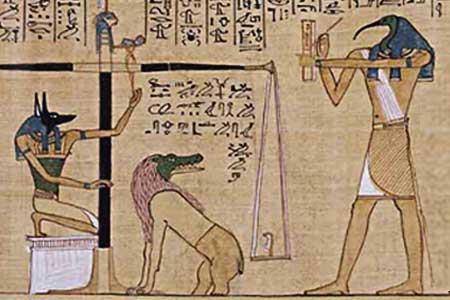
Papyrus Manuscript: Judgment Scene from the Book of the Dead of Hunefer c. 1275 BCE. In this richly illustrated papyrus, the ancient Egyptian scribe Hunefer embarks on his journey through the afterlife, guided by divine forces and judged according to the moral weight of his earthly deeds. The scene unfolds from left to right, beginning with the jackal-headed god Anubis leading Hunefer into the Hall of Judgment. Anubis is then shown overseeing the scales where Hunefer’s heart—depicted as a small jar—is weighed against the feather of Maat, the goddess of truth, justice, and cosmic order. To the Egyptians, the heart was the seat of intellect, emotion, and character, and its balance against Maat’s feather determined the soul’s fate. If the heart was found heavier than the feather, the deceased would be condemned to oblivion, devoured by Ammit, a terrifying hybrid creature with the head of a crocodile, the body of a lion, and the hindquarters of a hippopotamus.

But this was not Hunefer’s fate. As the papyrus was created to ensure Hunefer’s successful passage into the afterlife, he is shown having passed the test. Declared "true of voice" or "justified", he is led by Horus, son of Osiris, into the presence of the great god of the underworld. Osiris sits enthroned beneath a canopy, flanked by his sisters Isis and Nephthys, symbols of divine protection and resurrection. Above this central scene, Hunefer is depicted in reverent adoration before a row of deities who oversee the judgment process, affirming his acceptance into the eternal realm. This visual narrative not only reflects Hunefer’s personal hope for immortality but also encapsulates the broader Egyptian belief in moral accountability, divine justice, and the promise of life beyond death.

The Ancient Egyptian Book of the Dead depicts a scene in which a deceased person's heart is weighed against the feather of truth.
Ammit, "Devourer of the Dead", an Egyptian god with the forequarters of a lion, the hindquarters of a hippopotamus, and the head of a crocodile
The judgement of the dead in the presence of Osiris,Public Domain

 Sub-Menu THE RAMESSEUM
The Ramesseum is the mortuary temple of Pharaoh Ramesses II, also known as Ramesses the Great. It is located in the Theban Necropolis in Upper Egypt, on the west bank of the Nile River, directly across from the modern city of Luxor. At the heart of the complex, beyond the second courtyard, stood a covered hypostyle hall supported by 48 columns. One of the temple’s most remarkable features was a colossal statue of the enthroned pharaoh, carved from syenite. Originally standing 19 meters (62 feet) tall and weighing over 1,000 tons, only fragments of the base and torso remain today. Scattered remains of two additional seated statues that once flanked the temple entrance are still visible—one made of pink granite, the other of black granite.

One of the colossal granite heads from the Ramesseum temple—depicting Pharaoh Ramesses II—was transported to the British Museum in the early 19th century. In 1815, British Consul General Henry Salt commissioned engineer and explorer Giovanni Belzoni to retrieve the statue, known today as the Younger Memnon. Despite earlier failed attempts by Napoleon’s team, Belzoni succeeded using advanced hydraulic techniques and his engineering expertise. The 7-ton head arrived in London in 1818, where it quickly became a source of public fascination. It was eventually given a prominent place in the British Museum. The excitement surrounding its arrival, along with tales of ancient treasures still buried in the desert, inspired poet Percy Bysshe Shelley to write his famous sonnet Ozymandias, a reflection on the impermanence of power and legacy. The original statue would have stood 19 meters (62 feet) tall, rivaling the grandeur of the Colossi of Memnon and the monumental statues of Ramesses II at Abu Simbel.

1.) Fragments of the Great Colossi of Ramesses the Great, known as the Younger Memnon, moved to the British Museum, by Giovanni Belzoni in 1815
2.) Tinted Duotone Lithograph, by Louis Haghe (1806-1895), after painter David Roberts (1796-1864) March 1, 1847,
3.) The Ramesseum Mortuary Temple, 13th century BCE, Theban NecropolisPublic Domain
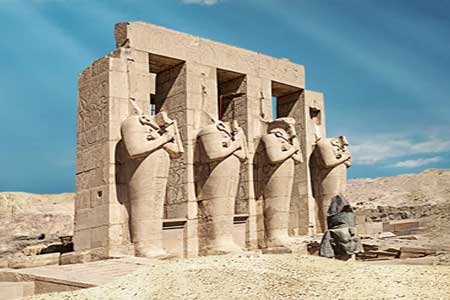
Entrance to the Hypostyle Hall of The Ramesseum Mortuary Temple, Theban Necropolis, 13th century BC, Luxor, Egypt.
Front of the Hypostyle Hall, Ramesseum Mortuary Temple, Theban Necropolis, 13th century BC
Statues of Osiris, the Egyptian god of the dead and afterlife, Ramesseum Mortuary Temple, 13th century BC
Collapsed Granite head of Pharaoh Ramesses the Great, Ramesseum Mortuary Temple complex
Ramesseum Mortuary Temple complex Necropolis, 13th century BC, Luxor, Egypt.
Hypostyle Hall complex, Ramesseum Mortuary Temple
Granite head of Pharaoh Ramesses the Great, (the smaller twin to the one in the British Museum, London)
The Younger Memnon, in the collection of the British Museum, London, England, since 1821, size: 2.7 metres (8 ft 10 in) high × 2 metres (6 ft 7 in) wide, It weighs 7.25 tons, cut from a single block of two-coloured granite, dated 1270 BC
Hypostyle Hall of Ramesseum Mortuary Temple
The ruins of Ramesseum Mortuary Temple, of Ramesses the Great, Theban Necropolis,
The toppled giant statue of Ramses the Great (by an earthquake in the 2nd century AD), it inspired the poet Shelley to write his poem Ozymandias,
Jackal-Headed Sphinx, Anubis depicted as a white jackal, he is god of the underworld who guided and protected the spirits of the dead
The ruins of Ramesseum Mortuary Temple, At Memnonium, Thebes Abstract/medium: 1 photographic print: albumen, 1856, photographer: Frank Mason Good,
The past & the present pillars and fallen colossus at the memnonium, of Ramesseum Mortuary Temple, Photo Abstract/medium: Antonio Beato, 1875,
The ruins of Ramesseum Mortuary Temple, At Memnonium, Thebes Abstract/medium: 1 photographic print: albumen, 1856, photographer: Frank Mason Good,

 Sub-Menu TOMB OF SETI I KV17
The Valley of the Kings serves as the majestic burial site of Pharaoh Seti I from the Nineteenth Dynasty, who reigned with distinction from 1290 to 1279 BC. Known as Belzoni's Tomb, it was unearthed by the renowned Italian archaeologist and explorer Giovanni Battista Belzoni on October 16, 1817. This tomb stands out as one of the largest, deepest, and most elaborately decorated in the Valley of the Kings. Spanning an impressive 137.19 meters (or 446 feet), it features stunning, well-preserved reliefs in all but two of its seventeen chambers and side rooms.

Seti I, referred to as Sethos I in Greek, was the formidable second pharaoh of the Nineteenth Dynasty during Egypt’s illustrious New Kingdom period, ruling approximately from 1294 or 1290 BC until 1279 BC. He was the son of Ramesses I and Sitre, solidifying a legacy that continues to captivate the world. Seti's tomb features the only vaulted ceiling in the Valley of the Kings, adorned with motifs and symbols representing the female hippopotamus constellation. This constellation was believed to guard the northern sky, protecting it from evil and preventing unworthy souls from passing through. The constellation is significant, as it wraps around the north celestial pole, forming a hybrid goddess with the head of a hippopotamus, the paws of a lion, and a body resembling a stellar snake. The imagery includes a hippopotamus alongside a crocodile holding a cane, with two ropes tied to the bull's tail, symbolizing the "Big Dipper."

In front of this scene is the goddess Serqet, accompanied by a falcon at her feet. Below the falcon are representations of a lion, a crocodile, and a man in battle. The man, adorned with a solar disk on his head, is holding the ropes, while Anu stands on the cane. All of these figures symbolize circumpolar stars, serving as a perfect metaphor for the Afterlife, as they appear never to set when viewed from Earth; they continually rotate around the pole star. These stars are known as the "undying" stars or, in Egyptian terminology, the "Indestructibles," making them an ideal destination for the soul of a deceased king. In ancient Egypt, the northern stars were regarded as "imperishable" or "undying," representing eternal life. According to the Pyramid Texts from the third millennium BC, the deceased pharaoh ascends to heaven and transforms into an imperishable star.

KV17 is also known as "Belzoni's tomb", it was uncovered by Italian archaeologist and explorer Giovanni Battista Belzoni on 16 October 1817.
Mummy of Seti I from the 13th Century BC
Map of Seti's Tomb KV17 one of the largest and deepest tombs in the Valley of the Kings
1.) In ancient Egypt, the wings of the goddess Isis symbolize protection, embracing, and transformation. Isis is one of the oldest gods in the ancient Egyptian pantheon.
2.) Isis's protective wings are seen in an Egyptian mourning posture that mimics Osiris's embrace. The wings also symbolize safety because they are depicted as spread out, which is a protective gesture in Egyptian art.
3.) Isis is connected to the symbol of the kite hawk and wings because of her ability to transform into a bird. She is often depicted with a moon disk and cow horns. Tomb of Pharaoh Seti I, KV17
1.) Paintings of hieroglyph prayers and offerings on the vaulted ceiling over the Tomb of Pharaoh Seti I, with the open wings of protection from goddess Isis,
2.) Isis's wings were thought to sweep away negative energies, shield her followers from harm, and guide them toward enlightenment.
3.) Isis' name is first attested in the fifth dynasty in the Pyramid texts. She was the wife of Osiris and the mother of Horus,
1.) The vaulted ceiling over Seti's tomb is painted with motifs and symbols of Circumpolar stars,
2.) which are stars that, due to their proximity to a celestial pole, never set below the horizon,
3.) for a given observer's location, appearing to circle the pole and remain visible all night, every night of the year.
1.) Detail of above, Fellow judges of Seti come to weigh his heart against a feather of Maat to determine his fate in the afterlife,
2.) If Seti's heart is lighter than the feather his soul passes into the afterlife,
3.) If Seti's heart is heavier than the feather his soul is consumed by Ammit, the "Devourer", and cast into darkness, KV17, Tomb of Pharaoh Seti I, 1292-1191 BCE.
1.) The sky goddess Nut depicted as a cow and supported by the eight Heh gods,
2.) the Book of the Heavenly Cow was discovered in the outermost gilded shrine of Tutankhamun,
3.) Three complete versions of the ancient text were discovered on the walls of the tombs of Seti I, Ramesses II, and Ramesses III.
1.) Fresco releif Depicting the Sun Boat with a Ram-Headed God,
2.) Book of Gates, second division (P)/third hour (H) solar bark, The snake represents royalty, divinity, and protection,
3.) Book of Gates, second division (P)/third hour (H) solar bark, The snake represents royalty, divinity, and protection,
1.) Book of Gates, second division (P)/third hour (H): solar bark.
2.) Book of Gates first and fourth divisions (P)/second and fifth hours (H). Courtesy of Uni Dia Verlag; Uni Dia Image Nr. 35771,
3.) Interior view of the famous Seti I, the first tomb decorated with god figures and hieroglyphs
Interior painting of Apopis, or Rerek, an ancient Egyptian demon of chaos, who had the form of a serpent snake, at the tomb of Seti I
The serpent held a complex and multifaceted role in ancient Egyptian culture, viewed with both fear and reverence. It served as a potent symbol of protection, royalty, divinity, and the cyclical nature of life and death
The serpent is a fascinating animal when it comes to Egyptian mythology. Their power with ancient Egyptians, was reflected in the duality of the serpent.
1.) Relief Depicting the Path Which the Dead Must Cross to the Afterlife, from the Tomb of Seti I Relief from KV17 Burial chamber J: Book of Gates, end of the 2nd hour, 4th gate and beginning of the 5th hour
2.) Uraeus serpents spitting fire, Our own Lady of Holy Fire… for Isis is a fiery Goddess
3.) Relief Depicting the Path Which the Dead Must Cross to the Afterlife, from the Tomb of Seti I
1.) Amduat, "Book of the Hidden Chamber" second hour, Boat with big lizard, Tomb of Pharaoh Seti I
2.) Imydwat, second hour Scarab Beetle, Tomb of Pharaoh Seti I,
3.) Imydwat, second hour, Hour 2, Ra officially enters the underworld, Tomb of Pharaoh Seti I
Osiris side chamber Jb Relief from KV17, the Tomb of Seti I side chamber Jb, face of pillar 1
The deceased Seti I as Osiris side chamber Jb Relief from KV17, the Tomb of Seti I side chamber Jb, face of pillar 2 Osiris between Imyut emblems
The deceased Seti I as Osiris. KV17, The Tomb of Seti I
1.) Painted Relief of King Seti I facing Thoth to receive the ankh egyptian symbol of the afterlife representing the ability to pass through the gates of death
2.) The Pharaoh receives from Thoth the royal emblems of the crook and flail insignia of pharaonic authority
3.) Horus performing the purification rite on "Osiris Seti", sprinkles a lustration of natron and water from three conjoined golden vases, Seti's Temple of Abydos
1.) Relief from Abydos, temple of Seti I Chapel of Amun-Ra
2.) Southern Wall, Upper register the King who stands in front of a great pile of offerings
3.) burning incense in front of the sacred boat, Abydos, Temple of Seti I, Chapel of Amun-Ra
1.) Chapel of Amun-Ra at Abydos of Osiris
2.) and Horus presenting Pharaoh Seti with the royal emblems of the crook and flail
3.) Seti's Temple of Abydos
Relief from KV17, the Tomb of Seti I, Burial chamber J, Face of pillar, Seti I before Osiris
Relief from KV17, the Tomb of Seti I, Burial chamber J, Seti I before Thoth
Relief from KV17, Tomb of Seti I, Pharaoh & Re-Horakhty, Pillared Hall:All Seti images kairoinfo4u

 Sub-Menu The Temple of Hatshepsut
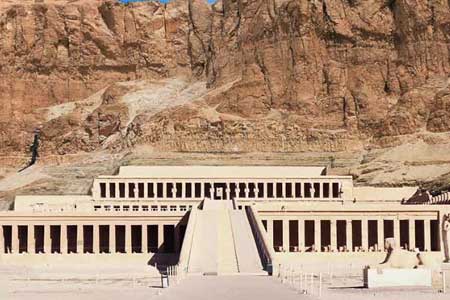
The Mortuary Temple of Hatshepsut, known as Djeser-Djeseru—meaning “Holy of Holies”—was built during Egypt’s Eighteenth Dynasty around 1500 BC. Located in the Valley of the Queens, across the Nile from Luxor, it is considered a masterpiece of ancient Egyptian architecture. The temple’s three massive terraces rise from the desert floor and blend seamlessly into the cliffs of Deir el-Bahari. Hatshepsut’s tomb, KV20, lies within the same mountain massif, topped by El Qurn—a natural peak shaped like a pyramid that symbolically crowns her mortuary complex. The temple’s sculptural style is known as the “Figure of Standing Osiris.” In these statues, Hatshepsut is depicted in the form of the god Osiris: upright and pillar-like, carved from stone, with a mummified appearance to emphasize divine transformation. Her arms are crossed, holding a flail and a short shepherd’s crook—symbols of Egyptian kingship. She wears a long braided beard and the Atef crown, which features a sacred cobra poised to strike, representing royal authority and protection.

Three massive terraces rise above the desert floor and into the cliffs of Deir el-Bahari
Entrance ramp with a gradual incline leading into the temple through a series of terraces
Her tomb, KV20, lies inside the same massif capped by El Qurn, a pyramid for her mortuary complex
Second level ramp incline leading into the Mortuary Temple of Hatshepsut
The ramp is guarded by the god Horus as a falcon and Osiride statues of Hatshepsut
Her tomb, KV20, is the shape of a pyramid for her mortuary complex
Osiride statues of Hatshepsut as upright pillars made of stone supporting the upper terrace
Punt portico of the middle terrace entrance ramp with a gradual incline leading into the temple through a series of terraces
A painted relief of the god Sokaris, presented with offerings of wine by Thutmose III
Balustrade entrance ramp adorned with a Falcon Bird Statue known as The God Horus as protection
Osirian statues at the door entrance to the shrines of Hatshepsut
A Hathor column, the goddess of music, dancing, and maternity maternity
Painted relief of the gods, Solar on the left, Hatshepsut center and Amun on the right
Painted relief of the vulture goddess Nekhbet
Magnificent painted relief of bestowed generous offerings
1.) A Hatshepsut standing Osiris colonnade, wrapped as a mummys,
2.) wearing a broad bead collars, bearded, crook and flail crossed over
3.) her chest, on her head is a Atef and the crown of Upper Egypt
1.) A series of reliefs depict her trading expedition to the Land of Punt -
2.) the soldiers bear tree branches and axes to signify peace -
3.) to the land of Punt located near the red sea on the Horn of Africa
A carved bust of Queen Hatshepsut
Hatshepsut's Chapel of Anubis, the God of The Dead bestowed with generous offerings
A Hatshepsut Standing Osiris column, wrapped as a mummy, wearing a broad bead collar, bearded, crook and flail crossed over her chest, on her head is a Atef and the crown of Upper Egypt
Statue of Queen Hatshepsut 1479–1458 B.C., carved limestone, in the collection of: Metropolitan Museum of Art, New York City
Relief of Osiris guarded by cobras
Colonnade of Colosses Osiriens standing statues of Queen Hatshepsut on lower terrace.
Hathor columns, the goddess of music, dancing, and maternity
Relief of Horus with a sun disk on the inter walls
The God Horus as a Falcon on the main entrance Balustrade ramp
1.)  a magnificent Colonnade of Colosses Osiriens statues of Queen
2.) Hatshepsut wrapped as a mummy, wearing a broad bead collar,
3.) bearded, on her head is a Atef and the crown of Upper Egypt

 Sub-Menu TOMB OF NEFERTARI, QV66
Often called the Sistine Chapel of Ancient Egypt, the Tomb of Nefertari was created around 1255 BCE. Nefertari, whose name means “beautiful companion,” was the favored wife of Pharaoh Ramesses II. His devotion to her was unmistakable—he referred to her as “the one for whom the sun shines” and commissioned the Temple of Hathor to honor her as a goddess. He also ordered the creation of elaborate wall paintings to immortalize her legacy. Located in the Valley of the Queens, the tomb offers rich insight into ancient Egyptian beliefs about the afterlife. The detailed scenes reveal ceremonial practices and highlight the roles of numerous deities during the 19th Dynasty of the New Kingdom. Gods depicted on the tomb walls include Isis, Osiris, Anubis, Hathor, Neith, Serket, Ma’at, Wadjet, Nekhbet, Amunet, Ra, Nephthys, Khepri, Amun, and Horus—each playing a part in guiding Nefertari’s soul through the underworld and into eternity.

After the tomb was discovered in 1904, scientists noted significant deterioration in many of its paintings. The damage was caused by water infiltration, bacterial growth, salt crystallization, and more recently, the humidity from visitors’ breath. Two major factors accelerated the decay: capillary absorption of trapped floodwaters into the tomb’s walls and the direct entry of floodwaters. In 1986, the Egyptian Antiquities Organization, in partnership with the Getty Conservation Institute, launched a restoration project to preserve the tomb’s artwork. They carefully removed over 3,000 years of accumulated dust and soot, and applied protective paper to the fragile walls and ceilings to safeguard the paintings. By 2006, access to the tomb was restricted to private tours of no more than 20 people, each requiring a special license costing US$3,000. As of December 2023, however, visitors holding a 2,000 EGP entry ticket or a premium Luxor Pass are permitted to enter

1.) Wadjet in the form of a winged cobra as protector, on the staircase to the Tomb of Nefertari
2.)
3.)
Anubis is the god of embalming and mummification, he is often portrayed as a jackal, or as a jackal-headed man
Nefertari plays Senet the oldest game in the world while on her journey to immortality
Anubis is the god of embalming and mummification, he is often portrayed as a jackal, or as a jackal-headed man
Egret and a Falcon guarding a bull and seven cows
Mural Painting of Heavenly Bull and Seven Cows
Mural Painting, eight mythological bovine cows of different colors in profile face offering tables
Guardians of the underworld: The messenger with a ram’s head, third door of the Kingdom of Osiris, chapter 144 of the Book of the Dead
Guardian At Fifth Gate Of Osiris' Kingdom Henty-reki
Taken from Spell 144 of the ‘Book of the Dead’, they were the keepers of the gates of the Underworld, menacing the enemies of order with their sharpened knives
Nefertari's journey to immortality, led by Isis a protector of the dead in the afterlife
Mural Painting of Queen Nefertari presenting nu jars before the offering table
Queen Neferati presenting scrolls to the Egyptian god Thoth, the inventor of writing and a scribe to the gods, he is depicted as a man with the head of an ibis
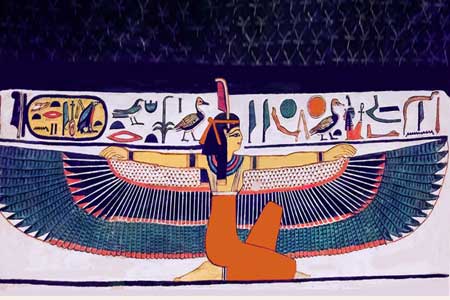
The Goddess Maat kneeling and spreading Her wings in protection toward the cartouche of Queen “Nefertari Beloved of Mut” at left of the cartouche, the ‘shen’-ring of protection
Egyptian god Khepri symbolises the Sun, rebirth, renewal and resurrection, he is depicted as a man with the head of a dung beetle
Nefertari's tomb staircase, the Goddess Maat guards the entrance to the Burial Chamber
Ra'a in a mummiform, Rams head and solar disc as a crown. Ra'a is flanked by Ises (Aset) (Iset) on the right and Nephthys (NbtHwt) on the left
Nekhbet guards the side chamber’s entrance, the vulture god appears on the antechamber’s lintel
The Queen wearing the falcon headdress is a Shuti consisting of two, tall ostrich or falcon feathers combined with a sun disk a symbol of divine law
Osiris God of the Underworld and Judge of the Dead, brother-husband to Isis
Mummiform Osiris, his skin is green, he clutches the emblems of power and wears the Atef crown and a false beard
Naos deity, guardian at fifth gate of Osiris
The keepers of the gates of the Underworld, menacing the enemies of order with their sharpened knives,
Queen Nefertari wearing a Vulture Headdress dating to the 4th and 5th Dynasties, a symbol of their divinity
Queen Nefertari before God Anubis in the Burial Chamber
The queen is making offerings of linen to the god Ptah, the creator god of weaving and crafts
Antechamber to burial chamber from Illustrated Book of the Dead depicting an egret and a falcon
Anubis, god of funerary practices, represented by a jackal or the figure of a man with the head of a jackal, Tomb of Nefertari, QV66, Thebes

 Sub-Menu TEMPLE OF HORUS AT EDFU
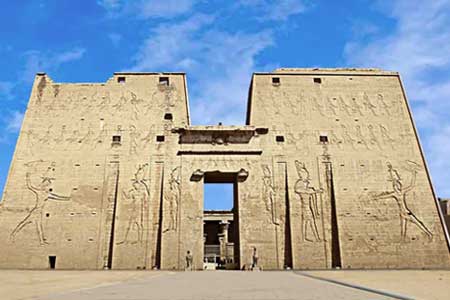
For over two thousand years, the Temple of Horus at Edfu, became buried to a depth of 12 meters or 39 feet beneath drifting desert sand and layers of river silt deposited by the Nile. Local inhabitants unaware of the temple built homes directly over the former grounds. Horus, a god in the form of a falcon bird, was a cult in its era, evidenced by late predynastic times and widespread in Egypt. This Ptolemaic temple, built between 237 and 57 BC, is one of the best-preserved ancient monuments in Egypt. It is the only temple with its roof intact and preserved by desert sand, which filled the temple after the pagan cult was banned. When approaching the temple, you may notice the two meticulously carved granite falcons flanking the entrance, acting as guards. In the present day, we are fortunate to be able to appreciate the splendor of this once-buried architectural gem.
1.) The main entrance of the Temple of Horus at Edfu, showing the first pylon
2.) It is one of the best preserved shrines in Egypt. The temple was built in the Ptolemaic Kingdom between 237 and 57 BC.
3.) The Temple of Horus fell into disuse following Emperor Theodosius I persecution of pagans and edict banning non-Christian worship within the Roman Empire in 391 AD
The granite sculpture of Horus left of the main entrance pylon of the temple, with a miniature of Caesarion (Ptolemy XV), son of Cleopatra VII, 33 BC, Temple of Horus at Edfu
The main entrance pylon of the Temple dedicated to sculpture in relief of Horus avenging his mother Isis and Osiris
The granite sculpture of Horus right of the main entrance pylon of the temple with a gouged out disfigured face, Temple of Horus at Edfu
Main entrance, first pylon, left side detail relief of the pharaoh Ptolemy XII, smiting the enemy Seth in front of the god Horus, Temple of Horus at Edfu
Relief of Horus and Seth from the throne of Seti I, 1550-1077 BCE, The Temple of Seti I, Abydos, Egypt.
Main entrance, first pylon, right side detail relief of the pharaoh Ptolemy XII, smiting the enemy Seth in front of the god Horus, Temple of Horus at Edfu
Detail relief of Horus, left of main entrance wearing a Pschent double crown, symbolizing the unification of Egypt, Temple of Horus at Edfu
Over the main entrance, sun disk flanked by 2 cobras and outspread wings: solar disk represents Ra, the sun god, Cobras represent the Uraeuses (Wadjet and Nekhbet), Falcon wings represent Horus, A symbol of protection.
Detail relief of Horus, right of main entrance wearing a Pschent double crown, symbolizing the unification of Egypt, Temple of Horus at Edfu
Relief of Horus and his consort Hathor left of the entrance, both wearing a Pschent double crown, holding the ankh that represents life and immortality.
Horus's wings, sun disk & cobras protecting the entrance to the sanctuary once brightly painted, is now blackened, by early Christians who sought to eliminate the worship of pagan gods.
Relief of Horus and his consort Hathor right of the entrance, both wearing a Pschent double crown, holding the ankh that represents life and immortality.
The falcon is the primary symbol of Horus, the sky god, his wings represent protection over doorways in Egyptian mythology, Gateway Ptolemy III Euergettes, Karnak Temple
Falcon Wings, Sun Disk & Cobras, Opet Temple, Originally built by Nectanebo I, 380 BCE, modified by Ptolemy III, 246 BCE and Ptolemy VIII, 170 BCE, Karnak Temple
As Horus was also considered the patron god of kings, the falcon wings above a doorway could also symbolize royal power. Horus Temple, built in the Ptolemaic Kingdom, 237-57 BCE, Edfu
1.) The back court of the Temple of Edfu, also known as the Court of Offerings, served as a public space where individuals could present offerings to the statue of the god Horus.
2.) Located beyond the first hypostyle hall, this court precedes the inner sections of the temple, including the second Hypostyle Hall, the Transverse Hall, and the Sanctuary.
3.) The walls of the forecourt feature carvings related to the Feast of the Joyous Union, an important festival celebrating the marriage between Horus and Hathor. Temple of Horus at Edfu
1.) The back court features statues of Horus, including a notable ten-foot-tall statue.
2.) Wall reliefs depict the pharaoh Ptolemy IX,Ptolemy X, & Alexander I) interacting with the victorious god Horus.
3.) A colonnade, with walls adorned with reliefs depicting scenes of the divine marriage of Hathor and Horus, Temple of Horus at Edfu
Relief of Horus and his wife Hathor, Temple of Horus, Edfu.
Relief of Pharoah Ptolemy VIII between the goddesses Wadjet of upper egypt and Nekhbet of lower Egypt, Temple of Horus, Edfu
Relief of Horus and his wife Hathor, Temple of Horus, Edfu
1.) Relief at Temple of Horus, Edfu, Horus and Isis
2.) Relief at Temple of Horus, Edfu
3.) Relief at Temple of Horus, Edfu
Relief of Horus and his wife Hathor and Isis holding the ankh, shaped like a cross with a loop at the top, that represents life and immortality.
Relief of Horus at work, Temple of Horus, Edfu
Relief depicting the reunion Horus and his wife Hathor and Sobek
1.) Relief painting in the Chapel of Horus dedicated to Osiris, Isis introduces Seti to her son Horus,
2.) The King raises his hand to receive from Horus the royal emblems of the crook and flail. Seti's Temple of Abydos, Egypt
Horus performing the purification rite on "Osiris Seti", sprinkles a lustration of natron and water from three conjoined golden vases, Seti's Temple of Abydos, Egypt
1.) All egyptians viewed Horus as the protector of the Pharaoh, he was an important unifying tool used to tie the people together under their leader,
2.) Horus the falcon god was Egypt’s first national god worshiped by all, the worship of Horus spanned over 5,000 years,
3.) He is one of the most significant deities who served many functions, most notably god of kingship and the sky, Seti's Temple of Abydos
1.) A detail of a wall relief representing Seti, Osiris and Horus,
2.) Relief of Osiris with original attributes crook and flail, symbols that represented his power and majesty,
3.) King Seti I receiving the royal flail and crook after death, from the god Horus as Osiris, Seti's Temple of Abydos, Egypt.
The souls of Pe a Falcon and Nekhen a Jackal kneeling atop Nome standards, the Greek Hierakonpolis was the Upper Egyptian centre of the worship of the god Horus
Seti and the God Ra as a falcon-headed man in anthropomorphic form of Ra as the god Horus, Seti's Tomb KV17,
Pe (Greek Buto) was a Lower Egyptian town, not known for its Horus worship, but Ra had awarded the town to Horus after his eye was injured in the struggle for the throne of Egypt
1.) The Hypostyle Hall at the Temple of Horus at Edfu, 2600 BC the architect Imhotep made use of stone columns highly decorated with carved and painted hieroglyphs, texts, ritual imagery and natural motifs.
2.) One of the most important type are the papyriform columns. The origin of these columns goes back to the 5th Dynasty composed of carved lotus (papyrus) stems.
3.) Many motifs of Egyptian ornamentation are symbolic, such as the scarab, or sacred beetle, the solar disk, and the vulture. Other common motifs include palm leaves, the papyrus plant, and the buds and flowers of the lotus.
4.) The column capitals in the Temple of Horus are of the highest order, including, like here, the magnificent Palm leaves capitals (above)
5.) The Temple of Horus at Edfu is one of the few ancient temples with its roof intact and the column capitals follow the forms of the lotus, the papyrus, and the palm.
6.) The Temple of Horus has column capitals in the shape of a papyrus with lotus flowers representing the cosmos. Columns in the shape of papyrus plants symbolized the sky, represented by the ceiling.
1.) The Temple of Horus & The Hypostyle Hall leading to the ceremonial boat of Hathor and the sacred bark of Horus are both located in the sanctuary. The temple of Horus at Edfu
2.) The sanctuary is the most sacred part of the temple and is made of black granite. It contains the shrine of Horus, the offering table, and the ceremonial boat. The temple of Horus at Edfu
3.) The sacred bark of Hathor was used in processions. Hathor was the patron goddess of love, beauty, pleasure, and music. The temple of Horus at Edfu
Temple of Horus, buried in sand, 1852, Photographed by Félix Teynard, French, 1817–1892, Salted paper print from paper negative,
The Temple of Horus, 1838, by David Roberts, 1796-1864, Watercolor, pen and ink, The Pierpont Morgan Library, New York City,
Temple of Horus, buried in sand, 1852, Photographed by Félix Teynard, French, 1817–1892, Salted paper print from paper negative,

 Sub-Menu MOUNT SINAI
Mount Sinai and Saint Catherine's Monastery built in 565 AD, by Emperor Justinian I, located on the Sinai Peninsula, Egypt, at the foot of Mount Sinai that claims to be the mountain of the burning bush where, according to the Torah, New Testiment, and the Quran, Moses received the Ten Commandments. The 7,500 foot climb to the top is part camel ride and then by foot. At the summit is "Moses' cave", where Moses was said to have waited to receive the Ten Commandments. During your visit don't miss the tour of the monastary it houses irreplaceable works of art: the best collection in the world of 120 icons dated back to the 5th and 6th centuries.

I on the boat suffering seasickness crossing the Red Sea after visiting the Temple of Horus in Edfu, Egypt
The view of the mountains of the Sinai Peninsula jetting up out of the sea is spectacular! This is where the myth of Moses on Mount Sinai spoke to Yahweh via a burning bush, and received the commandments.
Saint Catherine's Monastery built by the orders of the Byzantine emperor Justinian I, in 565 AD at the foot of Mount Sinai on the Sinai Peninsula
The oldest known image of Christ, 6th-century, encaustic (heated wax) icon on wood panel, Saint Catherine's Monastery, Mount Sinai Smarthistory: Saint Catherine's Monastery
I on a Camel going to the top of Mount Sinai at 7,500 feet.
That is Moi (holier-than-thou) on top of Mount Sinai.
Historic Images of MT SINAI
1.) Moses on Mount Sinai, Artist: Jean-Léon Gérôme, Oil on Canvas, First Exhibited: Paris, Cercle de L'Union artistique, 1895:
2.) The setting for Gérôme’s painting derives from descriptions of the Revelation in the Books of Exodus and Deuteronomy;
3.) “There was thunder and lightning and a heavy cloud on the mountain, and the sound of the ram's-horn and the people in the camp shuddered" Public Domain
1.) Mount Sinai 1723, An Illustration from the Aforementioned Book, Published: 1723, Amsterdam
2.) Source: Alle de werken van Flavius Josephus, Author: Jan and Kaspar Luikenpublic/domain PDM 1.0
The Ten Commandments, Bible Post Card, Published by: The Providence Lithograph Company, 1907, Source: Providence Lithograph CompanyPublic Domain
1.) Âs Sufsâfeh, (Mount Sinai), 1881, Contributor: Sir Charles William Wilson (1836-1905), Artist: John Douglas Woodward (1846-1924)
2.) Wood-engraver: William Jay Dana (1839-1913), Publisher: D. Appleton, Source: New York Public LibraryPublic Domain
Mount Horeb, Sinai, 1858, Francis Frith (1822-1898)Getty Museum
Website & Website & Content Created by Richard Brafford, © 2025, All Rights Reserved, Fair Use Disclaimer for Non-Commercial Use for Educational & Entertainment Purposes OnlyTop