The Book of the Dead is a New Kingdom funerary corpus (c. 1550–50 BC), written on papyrus and filled with spells to guide the deceased through the Duat (realm of the dead) and into the afterlife. Rather than a
fixed book, it is a fluid anthology drawing on earlier Pyramid and Coffin Texts; each manuscript differs in its selection, order, and imagery. Individuals commissioned personalized copies in
hieroglyphic or hieratic script, often illustrated with vignettes of the soul’s journey.
At the core of this tradition is the weighing of the heart. The deceased’s heart—believed to contain one’s intellect, emotions, and moral character—is weighed against the feather of the
goddess Ma’at, symbol of truth and cosmic order. If the heart failed to balance, it was devoured by Ammit, the fearsome composite creature of a crocodile, lion, and hippopotamus, and the
soul was condemned to non existence. If it balanced, the deceased was declared “true of voice” and admitted to the afterlife. (Below is a collection of Books of the Dead on Papyrus.) The Papyrus of Hunefer Starting at the bottom left: Hunefer in a white robe is led by Anubis with a head of a jackal that oversees the weighing of his heart against Ma’at’s feather, Thoth the ibis‑headed scribe
records the judgment, Ammut waits to consume a heart that fails the test, twelve gods preside over the scene above, (the Last Judgment, or weighing of the heart) to unfold in the Duat (realm of the dead) and features
the gods Horus the falcon-headed god of the sky, war, and kingship, and Osiris seated in a shrine, the green‑skinned god of the underworld wearing the white atef crown and holds the crook and flail, in front
of Osiris is Hunefer, the deceased scribe in a white robe; and Horus, the falcon‑headed god awaiting Hunefer's Judgment, standing behind Osiris in gestures of mourning and protection, is his sister‑goddesses Isis & Nephthys, a lotus bloom
before the throne supports the Four Sons of Horus, accompanied by protective imagery such as the soaring falcon.
Papyrus of Hunefer, (c. 1275 BCE), British Museum, 🅮Public Domain
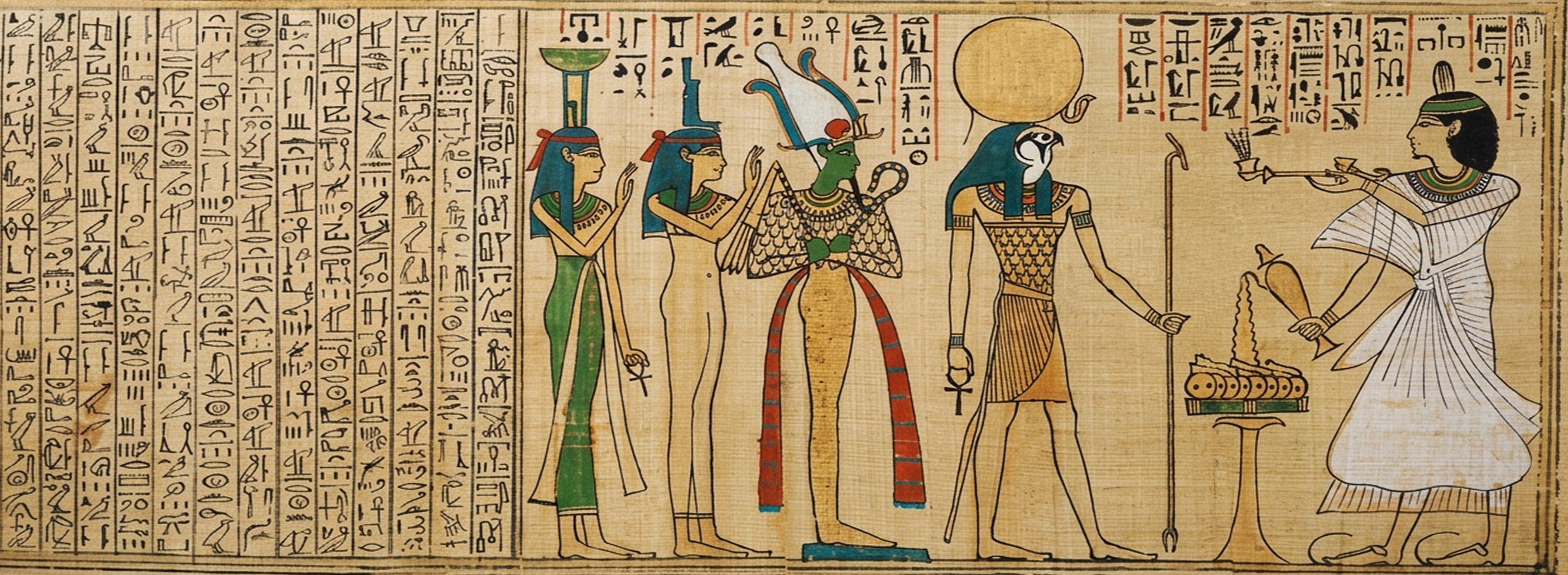
The Papyrus of Khonsumes The vignette of the funerary papyrus (Book of the Dead) of Khonsumes, A priest shown dressed in sheer pleated white linen holds an incense burner in one hand and pours a libation from a vessel over a small
altar topped with offerings, Khonsu receiving the offerings as the falcon-headed moon god, crowned with a large lunar disk wrapped by a protective uraeus cobra holds the was-scepter of power and authority in his
left hand and an ankh (the symbol of life) in his right, standing behind Khonsu is Osiris, the Lord of the Underworld, He is depicted with green skin (symbolizing fertility and rebirth) and tightly wrapped in
white mummy bandages while holding the ceremonial crook and flail, Isis and Nephthys flanking Osiris is his two protective sister-goddesses, Isis wearing her signature throne-shaped headdress,
and Nephthys wearing the symbol for a temple or house on her head. Both goddesses hold up their hands in a gesture of adoration and blessing. Hieroglyphic columns to the left contain magical spells,
religious formulas, and identifying labels translated from ancient funerary rites to protect the soul on its celestial journey
The Papyrus of Khonsumes, 1000 BCE, 21st Dynasty, Louvre Museum, Paris, 🅮Public Domain
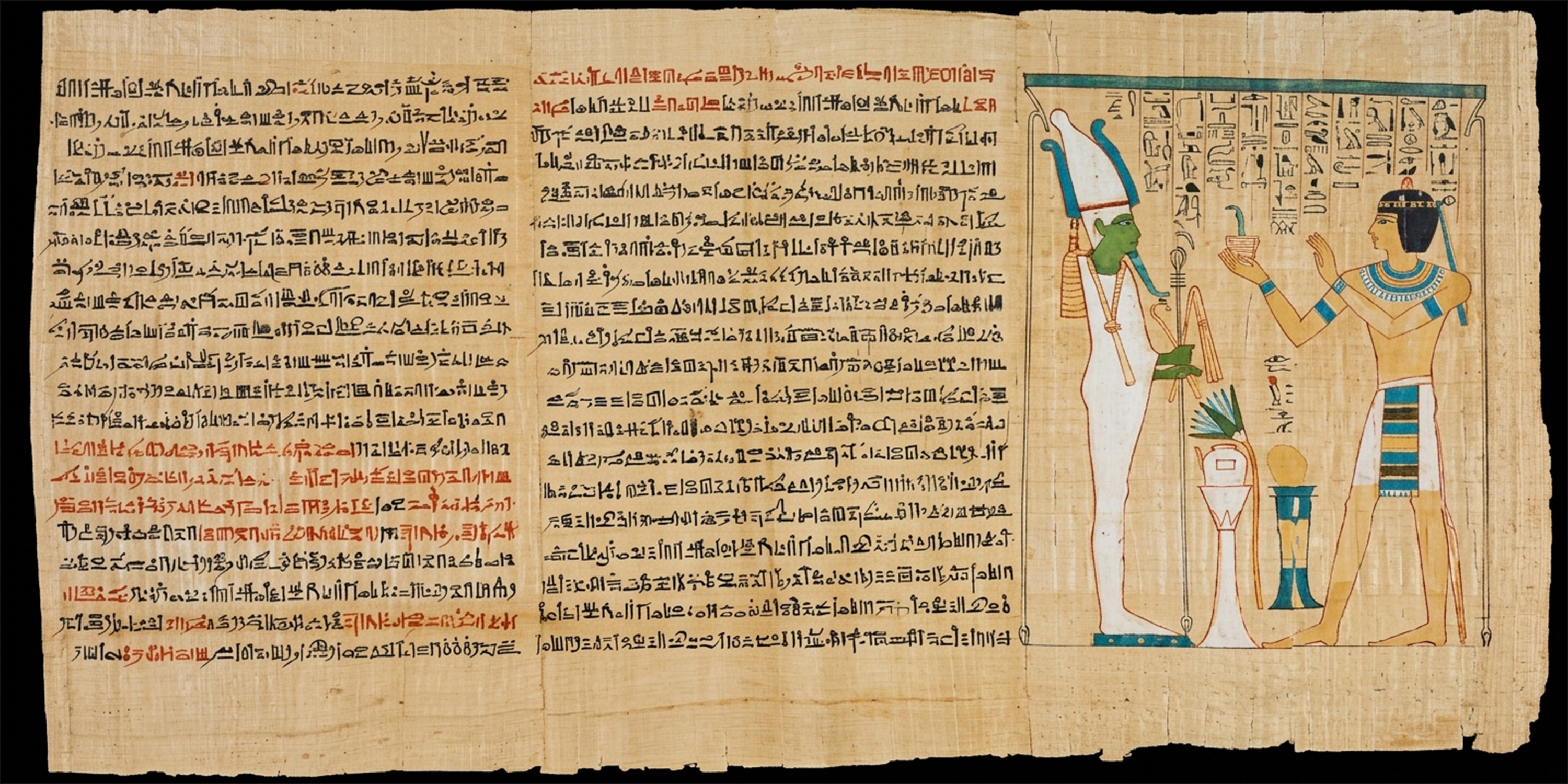
Book of the Dead of Pinedjem II Osiris and Pinedjem II Vignette, At left: Osiris appears in mummiform guise with green skin, the Atef crown, and the crook and flail, signaling rebirth and divine kingship. At right: Pinedjem II, High Priest of Amun in the Twenty‑First Dynasty, raises his hands in adoration, offering homage to the god.
Columns of red and black hieratic flank the scene, containing mortuary spells and prayers from the Book of the Dead to aid the soul in the afterlife.
990 BCE, 21st Dynasty, the British Museum, 🅮Public Domain
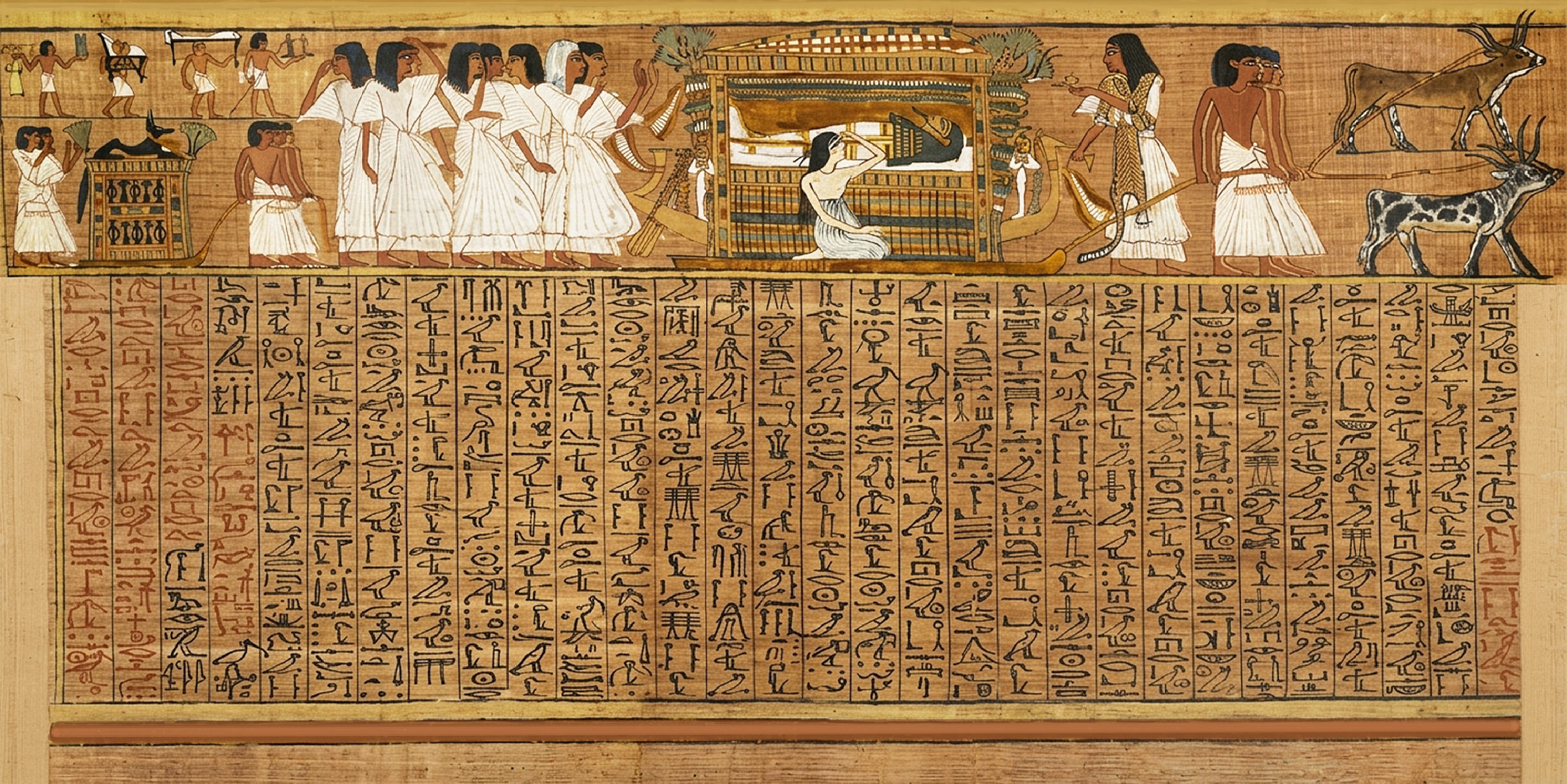
Papyrus of Ani
Funerary Procession as Ani’s mummy lies on a bier set upon a barque, itself mounted on a sledge drawn by four oxen and guided by attendants, Mourners and Deities: The cortege includes male attendants bearing funerary equipment, grieving mourners,
and Ani’s wife, Tutu, shown kneeling in lamentation. Isis and Nephthys flank the bier as protective goddesses, Ritual Actions: A sem‑priest in a leopard skin performs rites with incense and libations, while other attendants steady and prepare
the mummy for its final resting place.
Papyrus of Ani, 1250 BCE, British Museum, 🅮Public Domain
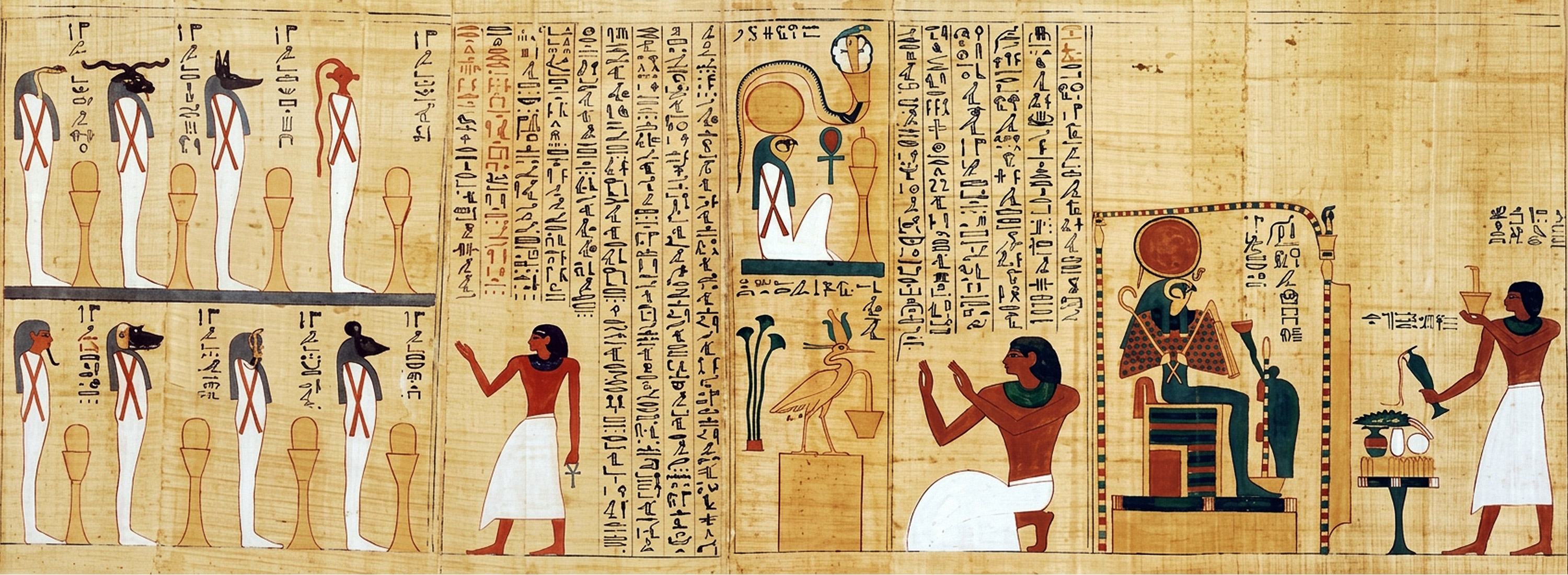
Mythological papyrus of Imenemsauf Far right: Scene: Imenemsauf performs rites before standing and seated deities, including animal headed gods. A priest pours libations and burns incense before Ra Harakhti and an offering
at the altar. Script & Medium: Papyrus with black and red hieroglyphic columns and polychrome vignettes. Ra Harakhti (Right Panel): A seated falcon headed god with solar disk and uraeus,
embodying the midday sun and cosmic authority. Solar Uraeus (Center): A rearing cobra supporting a solar sphere, the protective Eye of Ra. The papyrus affirms solar rebirth: Imenemsauf honors
Ra Harakhti through incense and libation to secure protection, purification, and renewal in the afterlife. Ra Harakhti embodies the midday sun’s supreme power, while the solar uraeus represents
the Eye of Ra, a force of fiery guardianship.
Mythological papyrus of Imenemsauf, 21st Dynasty of the Third Intermediate Period, circa 1069–716 BCE, Musée du Louvre, 🅮Public Domain
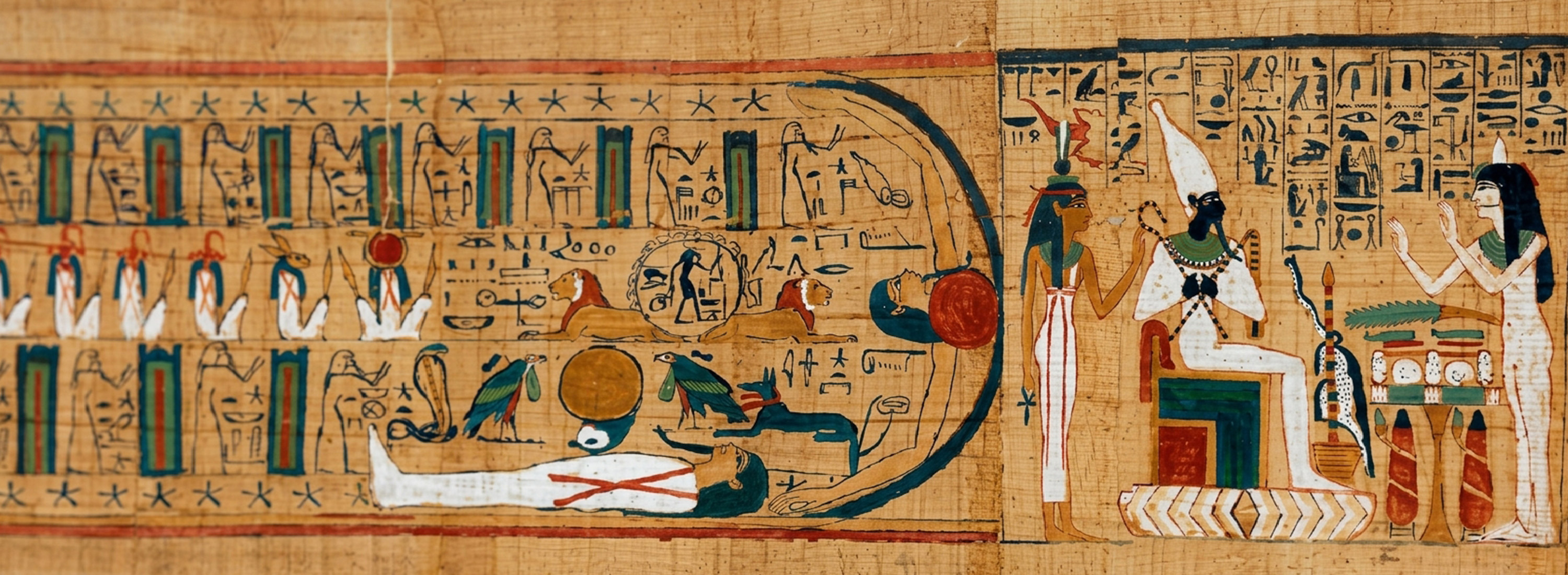
The Papyrus of Amduat
This vivid papyrus, found rolled between Gautsoshen’s thighs, shows three scenes of the Duat, the netherworld she traveled with the sun each night. At right, she stands before Osiris
and Selqet. In the center, the sun descends into the Duat, flanked by netherworld beings and twin lions symbolizing the horizons. The left registers depict further stages of
the sun’s nightly journey. A central inscription asks the god of the west to open the necropolis’s secret gates so Gautsoshen may “come forth as she wishes.”
Amduat ("What is in the Netherworld") papyrus inscribed for Gautsoshen, Dynasty 21,
Date: ca. 1000–945 BCE, The Met Fifth Avenue, 🅮Public Domain
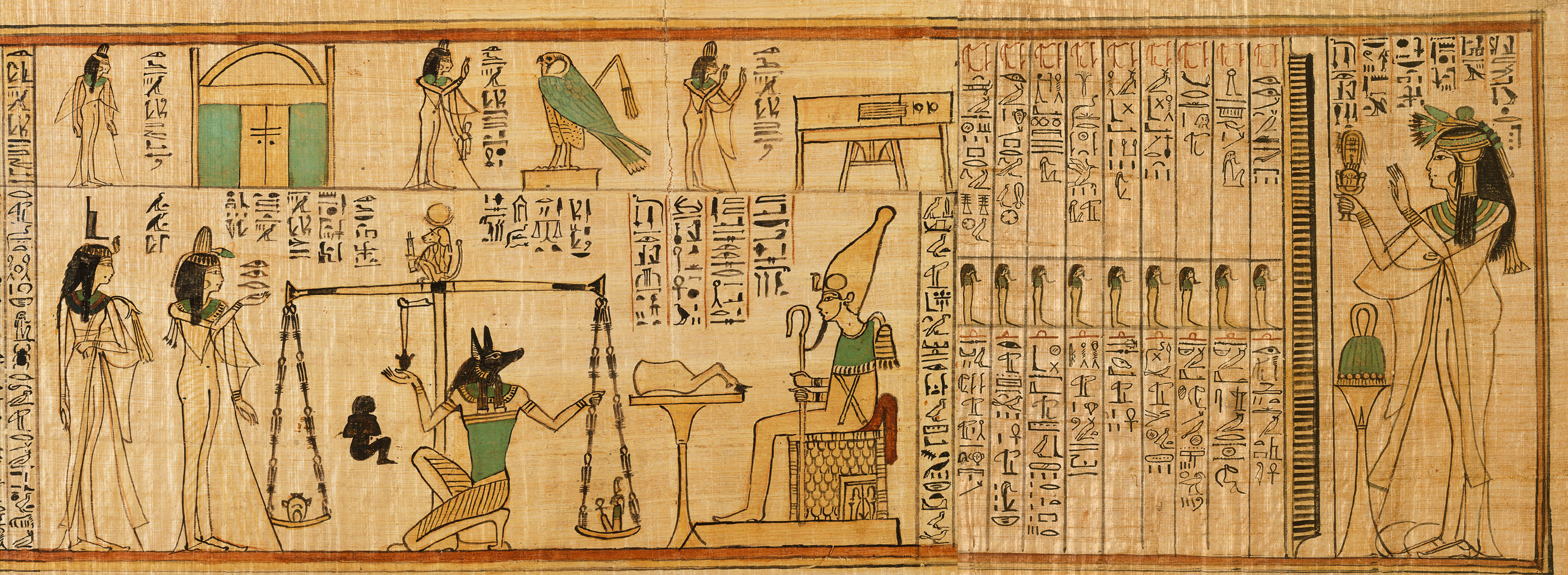
the Chantress of Amun, Naunyt Nauny’s Book of the Dead papyrus asserts her moral purity and right to rebirth. As a Chantress of Amun‑Re and daughter of the Theban high‑priestly line, she receives a long funerary scroll placed inside
a wooden Osiris figure, ensuring her protection and transformation. The central Weighing of the Heart (Spell 125) shows Nauny undergoing the decisive test of righteousness: her heart balanced against Maat,
the force of truth and cosmic order. Osiris presides as judge; Anubis reads the scales; Thoth, in baboon form, records the verdict; Isis stands behind Nauny as guardian and witness. If her heart aligns
with Maat, she becomes “true of voice” and gains entry into the blessed afterlife. The scene ultimately affirms Nauny’s justified status, her alignment with divine order, and her secure passage into the
Osirian cycle of renewal.
Book of the Dead for the Chantress of Amun, Nauny, Dynasty 21, 1050 BCE, The Met Fifth Avenue, 🅮Public Domain
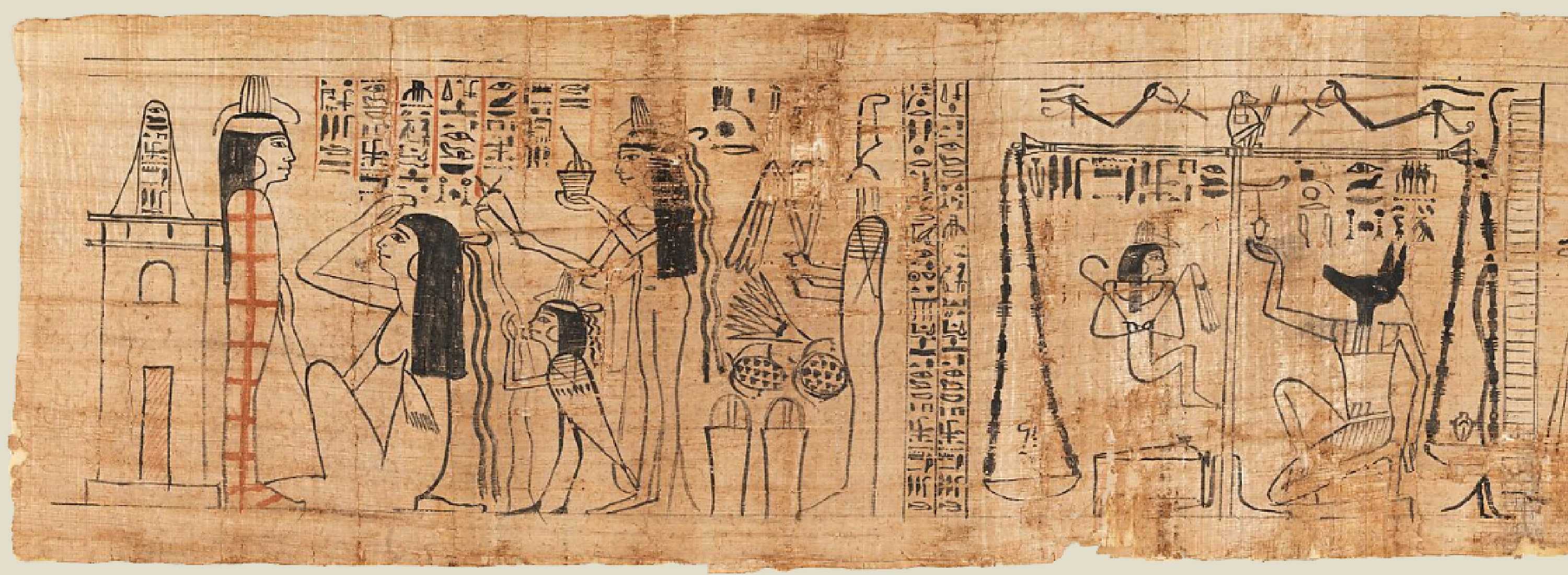
Papyrus of Tiye Tiye’s papyrus, found inside her hollow wooden Osiris figure, was created to secure her transition from death to eternal life. At left, her upright mummy stands before a tomb topped with a
pyramidion naming her titles. Two women mourn her—one seated in grief, another offering incense and libations—while Tiye’s ba‑bird raises its arms to receive the purifying water. A prayer above
petitions Osiris and the king for offerings. At right, Osiris as “god of the west” stands before a heap of provisions, marking the scene as part of Spell 1 of the Book of Coming Forth by Day. At
center is Spell 125, the Weighing of the Heart, where Tiye proves her moral worthiness. Anubis weighs her heart against Maat, the measure of truth; Thoth, in baboon form, records the verdict;
and the four sons of Horus stand beyond the doorway as guardians of her organs. Together, these scenes affirm Tiye’s purity, protection, and rightful entry into the company of Osiris.
Book of the Dead Papyrus of Tiye, Nauny, Dynasty 21, 975 BCE, The Met Fifth Avenue, 🅮Public Domain
 Top
Top